Sep 3, 2019
Differences in wall thickness cause changes in the speed of the melt front.
This can lead to air traps, weld lines, e.g..
To get a well balanced, homogenous flow behavior, increasing local wall thickness, called flow leaders, can speed up the flow front in a specific area.
Quality: The melt hesitates in the thin area leading to an
air trap (Image 1). By adding a flow leader the thin wall is increased and the
air trap gone (Image 2).
Related topics:
This glossary of plastic industry is provided by PLEXPERT Canada Inc.
Sep 12, 2024
The measure of a material’s resistance to the penetration of another (harder) body is called hardness.
In the plastics industry, hardness is used to evaluate the strength and resistance of a material. There are various measurement methods, including Shore hardness, Vickers hardness and Rockwell hardness, each of which measures different aspects of material properties. Hardness testing is important to determine the suitability of plastics for specific applications, particularly in areas where wear resistance and mechanical strength are critical.
Hardness values are often expressed in numbers, with higher values indicating harder materials.
The determination of hardness is a key aspect of material testing and development in the plastics industry.

Quality: Conventional
hardness test: (1) Load up to the test load, (2) Creep process under test load, (3) Elastic recovery
Related topics:
Plastic testing
This glossary of plastic industry is provided by PLEXPERT Canada Inc.
Mar 10, 2026
Mechanical surface stiffness of elastomeric materials is determined using measuring systems that record the penetration of a defined indenter under controlled force. In Micro-Shore A and IRHD-Micro testing, the penetration depth of a standardized indenter into materials such as rubber or other elastomers is measured with high precision. A hardness testing device enables this measurement under reproducible conditions and provides quantitative values for evaluating material properties, quality, and aging behavior. Micro-hardness testing is particularly advantageous for thin samples, small components, or localized material analysis due to its high measurement accuracy and comparability.
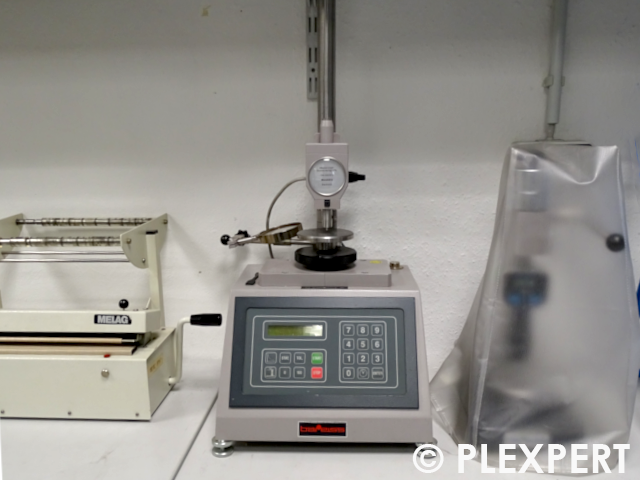
Quality Assurance: Classic measuring device for
hardness testing
Related topics:
This glossary of plastic industry is provided by PLEXPERT Canada Inc.
Mar 19, 2026
An interchangeable probe is used in instrumented hardness testing to penetrate the surface of a material in a controlled manner and determine its resistance to plastic deformation. The geometry and material of this test element are precisely defined to ensure reproducible measurement results. Different shapes — such as spherical, pyramidal, or conical geometries — allow the testing device to be adapted to various materials and hardness ranges. In plastics engineering, this element is mainly used in indentation based test methods, in which force and penetration depth are continously measured. This enables the determination not only of hardness but also of additional mechanical material properties.
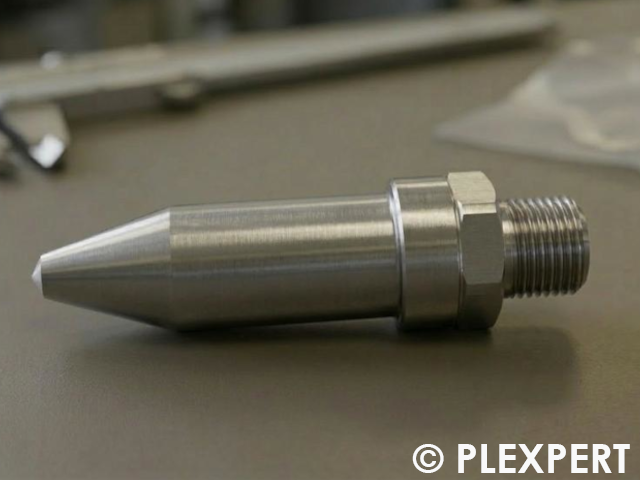
Quality Assurance: Conical
indenter for screwing into a
hardness tester
Related topics:
Instrumented penetration testing
Penetration depth
This glossary of plastic industry is provided by PLEXPERT Canada Inc.
May 10, 2019
One important characteristic to determine the quality for injection molding production is the pressure inside of the cavity.
The pressure can be detected using pressure sensors that measure either directly or indirectly.
An advantage of the indirect sensors is the positioning in the clamping plate of the mold (ejection side).
There is no need for maintanance or removing the sensors if the mold is disassembled for service.
Therefore, the risk of violating the wires of the sensor is more or less zero. Both Sensor and wires are protected by the pressure plate and a stainless steel cover.

Quality:
Pressure sensor for the indirect measurement of the
cavity pressure.
Related topics:
This information and services are provided by:

This glossary of plastic industry is provided by PLEXPERT Canada Inc.