Oct 6, 2019
Cavity pressure can be determined directly, indirectly and contact-free.
Cavity pressure sensors are mostly Piezoelectric Sensors. The directed deformation of a piezoelectric crystal creates an electrical charge. The charge signal, which is proportional to the pressure, is converted into electrical voltage using a charge amplifier. Highly dynamic pressure progressions can be measured using this technology.
Direct-measuring sensors are in contact with the melt in the cavity, and they measure the pressure without transmission pins. These sensors provide also a very wide pressure range and a very robust design of the sensor.
An advantage of direct pressure sensors is the very accurate measurement of the cavity pressure. On many sensors, the front can be adapted to the surface of the cavity so that no mark can be seen on the part. Combined pressure/temperature sensors measure the cavity pressure and the contact temperature at the same point on the part.
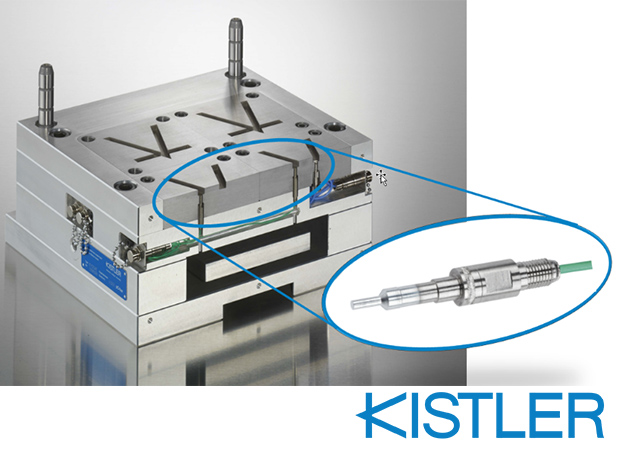
Quality: Direct
Pressure Sensor inside a
mold.
Related topics:
This information and services are provided by:

This glossary of plastic industry is provided by PLEXPERT Canada Inc.
Nov 20, 2019
For a finite element (FE) calculation the body to be calculated is described using many small elements.
The elements may be points, linear, planar or solid.
The division into smaller parts (finite elements) is called meshing or discretization.
It looks like a mesh, which is laid over the part.
Today simulation programs take over the discretization partially or completely automatically.
This way an idealized model is produced to be processed for the calculation.
It is important to pay attention to the mesh density: The absolute value of all results always depends on the mesh density. Therefore, it is important that the same mesh density is chosen for each calculation variant so that differences in the calculation results are not due to different element sizes. It should also be noted that the numerical complexity and thus the calculation time increases overproportionally as the number of elements increases.
Each element is assigned certain properties.
Flat elements, for example, can be assigned the wall thickness, or line elements their cross section.
For each individual element the correspondign equations are calculated.
These are for example the deformation do to loars, the speed due to changes in volume flow, or the temperature change due to heat input.
For the entire component, the individual equations are combined in an overall matrix. Therefore it is possible to calculate arbitrary complex geometries.

Simulation:
Discretization with shell elements on the surface of a box
Related topics:
This information and services are provided by:

This glossary of plastic industry is provided by PLEXPERT Canada Inc.
Jul 17, 2019
A statistical experimental design, with specific information about the experiments, needs to be provided in advance to reach an optimized result.
This process is called DoE – Design of Experiments.
In order to save resources, statistical methods are used to reduce the effort between carrying out tests in relation to the accuracy of the obtained results.
For this one or more aims are set. In injection molding, this might be cycle time reduction, lower warpage, …
The changeable factors (injection time, melt temperature, packing pressure…) and their allowed range will be set as well.
On this base, an experimental design is created. It describes which experiments are to be carried out in which order.
The results of each experiment are determined for a final evaluation.
After the DoE, the information about how much each factor influences the aims is displayed. Furthermore, the combination of all the factors which comes closest to the requested aim is shown.
Today, software is used to carry out DoE, as these provide more cost-effective results than experiments in practice.

Quality: The
DoE calculates the influence of each factor for the requested aim.
Related topics:
This glossary of plastic industry is provided by PLEXPERT Canada Inc.
Feb 13, 2025
The process in which plastic granulate is melted in the plasticizing unit and prepared in the required amount for the next injection cycle is called dosing.
During this process, the screw conveys the material forward while it melts through friction and external heating. The screw moves back axially, forming a defined melt cushion. A non-return valve prevents the material from flowing back into the rear section of the screw. The dosing amount is precisely controlled to ensure consistent cavity filling and reproducible part quality. Factors such as temperature, screw speed, and back pressure influence the dosing process and, consequently, the melt quality. Accurate dosing is crucial for the efficiency and quality of the injection molding process.

Injection molding machine: Schematic representation of the
dosing process
Related topics:
This glossary of plastic industry is provided by PLEXPERT Canada Inc.
Jan 25, 2019
During Cooling, the injection molded part shrinks onto the mold components.
For ejection of the part, draft angles are used.
If they are missing, it might lead to no ejection of the part, or visible scratches or scoring arise during ejection.
Dependent on material and surface, different draft angles are chosen:
Amorphous materials need larger draft angles on a rib than semi-crystalline materials.
On the other hand, if the part shrinks to a core, it is vice versa.
The higher shrinkage of semi-crystalline materials is the reason for this.

Quality: A cut through the
part without (left) and with (right)
draft angles.
Related Topics:
This glossary of plastic industry is provided by PLEXPERT Canada Inc.