May 25, 2021
Deposits, e.g. caused by outgassing of additives during the production of plastic parts, contaminate the surfaces of tools. This can lead to problems with venting, among other issues.
Effective and gentle cleaning of the surfaces of injection moulds can be achieved by using dry ice. This is produced from liquid carbon dioxide (CO2).
In a so-called pelletizer, the (compressed) liquid carbon dioxide is expanded under atmospheric pressure. This physical process produces dry ice snow. This is pressed through an extruder plate to produce round, hard dry ice pellets. These are elongated grains with a diameter of 3 mm.

Dry ice after being in the pelletizer
Related topics:
This information and services are provided by:

This glossary of plastic industry is provided by PLEXPERT Canada Inc.
May 25, 2021
Contamination on mold surfaces can have various causes and must be eliminated in order to produce molded parts with high quality.
One method of cleaning is dry ice blasting. This is similar to sandblasting, but much gentler. Dry ice pellets are used as the blasting medium.
The pellets are accelerated to extremely high speed in the dry ice blasting unit with a jet of compressed air and blasted onto the object to be cleaned using a gun and nozzle.
Upon impact with the surface, mini-explosions occur which, in combination with the locally generated cold shock (-78.5°C), detach dirt particles from the substrate.
Quality assurance: Dry ice unit with compressed air hose and
dosing gun
Quality assurance: Cleaning method
Related topics:
Dry ice
This information and services are provided by:

This glossary of plastic industry is provided by PLEXPERT Canada Inc.
Oct 13, 2020
One of the most basic gates for injection molding is the edge gate.
The gate normally has a rectangular cross-section along the parting line of the mold to connect the runner system with the mold cavity.
The common edge gate is positioned on the side of the cavity.
It can be easily manufactured by a basic machining process such as milling.
The disadvantage of the edge gate is the remaining of the connection of the molded part to the runner after ejection.
Additional mechanical action is needed for separation. Furthermore jetting might occur with this kind of gate.
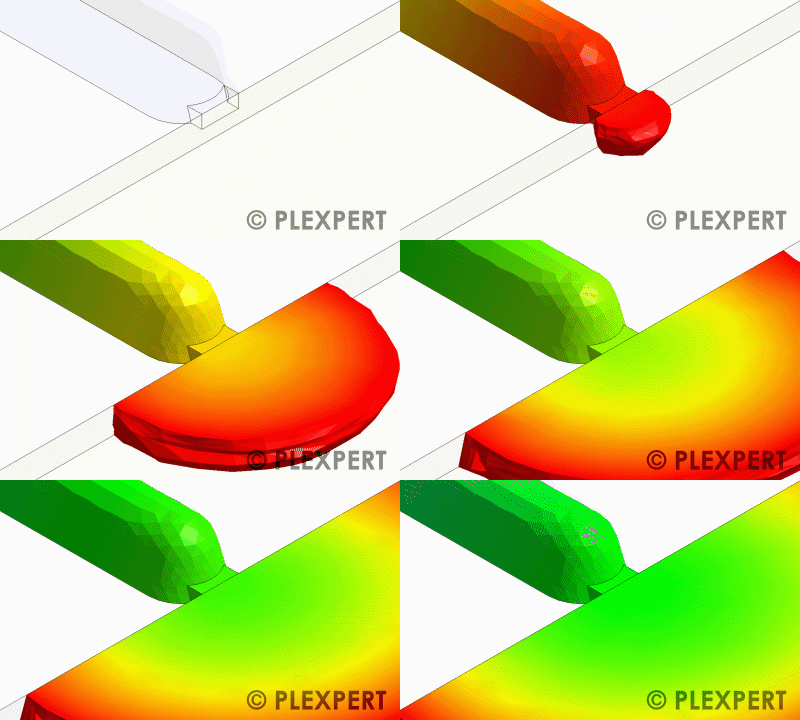
Injection
mold: A
common edge gate is filling the
part from the side
Related topics:
Banana Gate
This glossary of plastic industry is provided by PLEXPERT Canada Inc.
Nov 27, 2018
A mold is usually divided into two sides according to their function.
The side with the ejector pins is called ejection side.
This side is moved for mold opening, therefore another common name is “movable side”.

Nov 21, 2018
To get the parts homogeneously and with as least as possible tension out of the cavity, ejectors are used.
Additional ejectors can be set as optimization for the venting system.
The ejectors are mainly axial pins, which are located on the ejector plate and fixed from the ejector holding plate.
The movement of the ejector plate takes place most of the time by hydraulic.
When moving forward, the pins press against the parts and throw them out. The backwards movement is done by hydraulic or spring force.
The movement of the ejectors has a big influence on the wear of the mold.