Jun 1, 2021
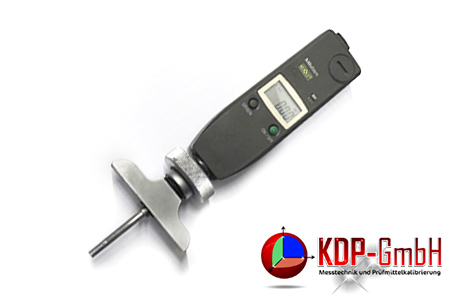
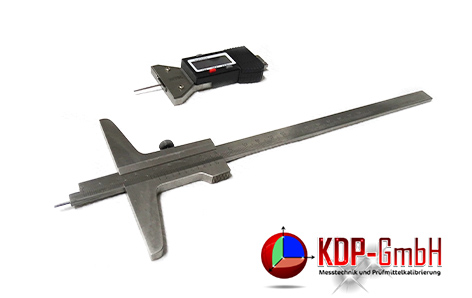
A standard Caliper with integrated measuring bridge, but without measuring blades is called depth caliper.
It can be used to measure the depth of holes (which don’t pass through) or grooves.
Function and design are almost identical to the standard caliper.
With mechanical depth calipers, the determined measurement is read off via the vernier.
For the digital version the value can be seen on the display.
Measuring Technology: Depth Caliper (analog and digital) for measuring depth of holes or grooves.
Measuring Technology: Depth Caliper
Related topics:
Height Gauge
This information and services are provided by:

This glossary of plastic industry is provided by PLEXPERT Canada Inc.
Oct 13, 2020
The air that we breath and around us is in general a mixture of gases with a certain level of humidity. This mix of humid gases may contain steam and air.
Steam may be exchanged by other condensable elements, air by specific gases.
The dew point is defined as the temperature of a humid gas in condition of equilibrium where condensation and vaporization is in balance. The gas is therefore just saturated.
The dew point of compressed air at 6 bar is -40 °C. This dew point should be used to avoid water in the pneumatic system and/or water drops on plastic parts, when blown off.
To assure an efficient drying of plastic resins, the used heated air should provide a dew point of 0 °C.

The
dew point in the phase diagram is situated on the yellow line between gaseous (gray) and liquid (purple) dependent on the respective
pressure.
Related topics:
This glossary of plastic industry is provided by PLEXPERT Canada Inc.
Nov 30, 2021
Following „first-time-right” principles, a Design for Manufacturing analysis (DFM) is an essential part of a successful product development and industrialization.
DFM describe a study where, the part design is screened and checked in full depth.
Only part designs fit for the selected manufacturing process shall enter industrialization.
All critical to quality (CTQ) part characteristics should be able to be produced within a reliable processing window and at lowest processing costs possible.
Lately also sustainability is getting more and more attention and the DFM-study is also including sustainability objectives.
A DFM is including also injection moulding simulations.
With this filling- , warpage- and cooling-simulation and can be extended to a CAE-based DOE.
Quality:
CAD design with critical sections identified
Quality Assurance: Detailed information about critical section (wall thickness too high)
Related Topics:
First-time-right
This glossary of plastic industry is provided by PLEXPERT Canada Inc.
Nov 20, 2019
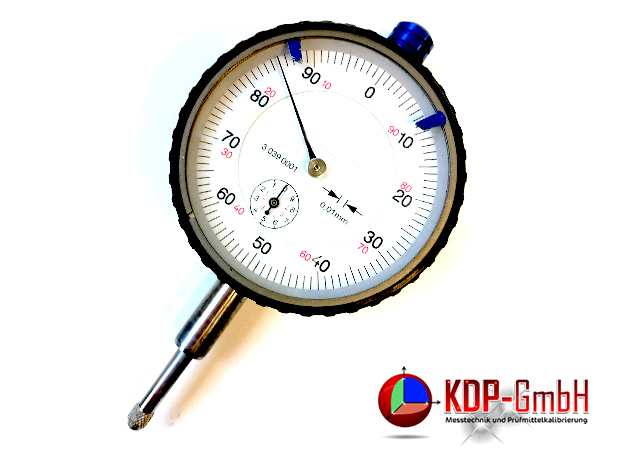
Length or differences in length are measurend with a dial gauge. It can be used for comparative, flatness, positional or concentricity measurements.
Dial gauges exist with analogue or digital display. Setup and function are standardized by DIN regulation 878.
Dial gauges with round scale and analogue display transmit the longitudinal movement of the measuring probe with a toothed rack and gear to the pointer. As a result, the pointer of the dial gauge rotates several times in a circle. The number of revolutions is indicated by a second pointer, similar to the hour hand of a watch.
The advantage of the gear rack transmission is the relatively large measuring range. The disadvantage is, that if the measuring distance greatly exceeds the travel range of the rack, it might lead to gear damage or rack damagein case of a rigid locking of the dial gauge.
Alternativly there are dial gauges with slave pointer with a delayed point of return. However this kind of dial gauges cannot carry out measurements with value differences, like concentricity or flatness.
In addition a great advantage of a dial gauge is, that it can be used in pressure and tension mode and that the return of the measuring rod is done with a spring. Therefore the applied measuring force is almost constant.
Most dial gauges achieve an accuracy level of approximately 10 µm and have a measuring range of 5 to 60 mm. A few dial gauges have an accuracy of 1 µm.
Measuring technology:
Dial gauge for the measurement of length and differences in length.
Related topics:
This information and services are provided by:
This glossary of plastic industry is provided by PLEXPERT Canada Inc.
Sep 26, 2024
A virtual image of a physical object or system that simulates and analyzes its behaviour and properties in real time is called a digital twin.
This technology makes it possible to optimize processes, reduce costs and speed up product development by allowing accurate predictions and adjustments.
In the field of injection molding, a digital twin of the molded part tool can be used to monitor and improve the production process.
By simulating the tool, potential problems can be identified and rectified at an early stage, resulting in higher quality and efficiency.
The digital twin thus connects the physical and digital worlds and creates new opportunities for innovation in the production process.

Automation: Injection
mold and its
digital twin
Related topics:
This glossary of plastic industry is provided by PLEXPERT Canada Inc.