Mar 2, 2020
The maintenance of an injection mold is often determined by the number of shots. Where a shot represent one cycle in the injection molding process.
In order to determine the number of cycles a cycle counters can be mounted onto the mold.
A pin is usually pressed into the counter while the mold is closing. Thus the counter is moved one step further.
But it need to be kept in mind that this means the counter does not check whether parts are actually produced or nut, but show how often the mold was closed.
The cycle counter that can be set on the machine controller can be reset to zero any time. This, and the fact that the mold can be used for production on different machines, makes the cycle counter on the machine controller not usable to determine the total number of shots done.

Feb 1, 2022
To indicate on technical drawings that a shell surface must lie between two coaxial cylinders, the symbol of the cylindrical shape is indicated.
No reference point is described but only the radial distance between two coaxial cylinders, which are placed around the toleranced shell surface.
Cylindricity is a form tolerance.
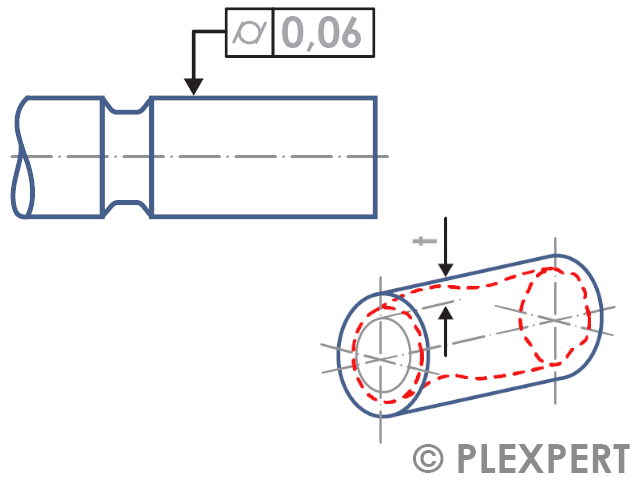
Quality Assurance: Tolerated shell surface with a distance of the imaginary cylinders of 0.06mm
Related topics:
This glossary of plastic industry is provided by PLEXPERT Canada Inc.
Feb 28, 2020
The highest industrial calibration standard in Germany is the DAkkS-Calibration.
It has the highest reliability, is internationally recognized and is binding in court.
DAkkS-calibration certificates are required for:
– automotive industry (IATF)
– pharmacy/ medical technology
– factory standards
The DAkkS (german accreditation agency) is the national accreditation agency of Germany.
According to the Regulation (EG) No. 765/2008 and the Accreditation Body Act (AkkStelleG), the DAkkS acts in the public interest as sole provider of accreditation in Germany.
The accreditation and surveillance of laboratories, inspection and certification agencies (conformity assessment agencies) ensures quality, confirms competence and creates confidence in the results.
For manufacturer, conformity assessment agencies and consumers this procedure is therefore absolutely transparent.

Mar 8, 2019
Square or triangle elements are mostly used to generate a mesh for a simulation.
When two or more nodes of one element fall on the same coordinate the element is called a degenerated element.
This way a square can become a triangle, a line or even a point.
Depending on the used program the multiple nodes will be joined automatically to one node or need to cleaned up manually.
Degenerated elements exist in volume elements as well.
A hexahedron can degenerate to a prism or tetrahedron.
Degenerated elements lead to wrong results in the simulation or even block the start of an simulation.

Simulation: When two points of a square fall onto the same coordinates a
degenerated element is built.
Related topics:
This glossary of plastic industry is provided by PLEXPERT Canada Inc.
Oct 16, 2019
The demoulding process takes place at the end of each injection moulding cycle. Sometimes unfavourable demoulding conditions result in a loss of quality, such as ejector marks or stress whitening. These problems can often not be remedied by technological variations as many influencing factors are already to be found in advance with regard to material selection, plastic and process-relevant moulded part design as well as mould design. In order to investigate the demoulding behaviour and to improve it, there are measuring approaches, such as the demoulding force measurement, which are aimed at achieving practice-relevant results. For this purpose, force sensors are used in the ejector package. As a result, among other things, an analysis of the effectiveness of mould coatings or additives can be made and the demoulding force can be reduced.

Measuring technology: The
demoulding force measurement shows the impact of
additives on the ejection
Related topics:
Angle
This information and services are provided by:

This glossary of plastic industry is provided by PLEXPERT Canada Inc.