Nov 16, 2018
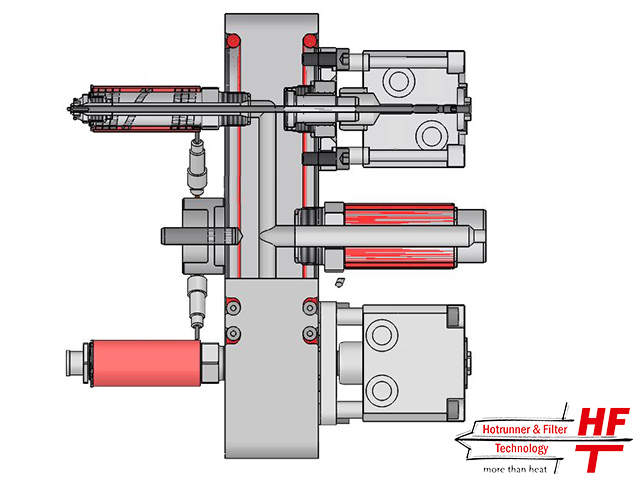
In the injection mold, the hot runner system is thermally isolated with the help of the air gap.
Due to the acting forces it is necessary to use supports of the hot runner system as connection to the surrounding wall of the mold.
To get a preferably low heat lot, Titanium or ceramic is used as material for the support.
Furthermore, the aim is to keep the support as small as possible, but as big as necessary.

Dec 6, 2018
The transportation of the molten plastic from the injection unit through the mold to the cavity can be done by a hot runner system.
This consists of at least one sprue bushing, the manifold and one or more hot runner gates.
The single components are provided with heaters, which are controlled by suitable PID-Controllers, to achieve a uniform temperature distribution. The system, on the other hand, is thermally decoupled from the mold so that there is a homogeneous heat balance inside the hot runner system.
Advantages of a hot runner system are for example the saving of material and the reduction of the cycle time.
There are different versions of hot runner systems.
The simpliest is the hot runner system with thermal lock.
At the end of the injection and packing phase the melt is cooling down at the gate due to the heat transfer in the colder mold.
The viscosity of the plastc decreases and a “thermal lock” develops, which prevents the melt from entering into the cavity.
Hot runner systems with valve gates are commonly used.
A needle is added to the gates. It can be moved by cylinders (hydraulic or pneumatic) allowing or preventing the melt to enter the cavity.
Advantages of the usage of valve gates are the controllable filling of the parts and that the break-off point can be designed without a residual pin.
Mar 6, 2025
The sampling of injection molding tools is crucial for a company’s economic efficiency. A structured and documented approach to sampling ensures high product quality.
This important process is digitalized with the IMG (Injection Molding Guide). The IMG is a digital process guide that ensures safe sampling. The user is guided through the sampling process in 10 steps.
All necessary data, such as material data sheets, CAD datasets, and machine data, are available at the touch of a button. All data is centrally managed in an SQL database within the company network for future access.

Automation technology: Display of master data for a new
mold sampling
Related topics:
This glossary of plastic industry is provided by PLEXPERT Canada Inc.
Mar 19, 2026
An interchangeable probe is used in instrumented hardness testing to penetrate the surface of a material in a controlled manner and determine its resistance to plastic deformation. The geometry and material of this test element are precisely defined to ensure reproducible measurement results. Different shapes — such as spherical, pyramidal, or conical geometries — allow the testing device to be adapted to various materials and hardness ranges. In plastics engineering, this element is mainly used in indentation based test methods, in which force and penetration depth are continously measured. This enables the determination not only of hardness but also of additional mechanical material properties.
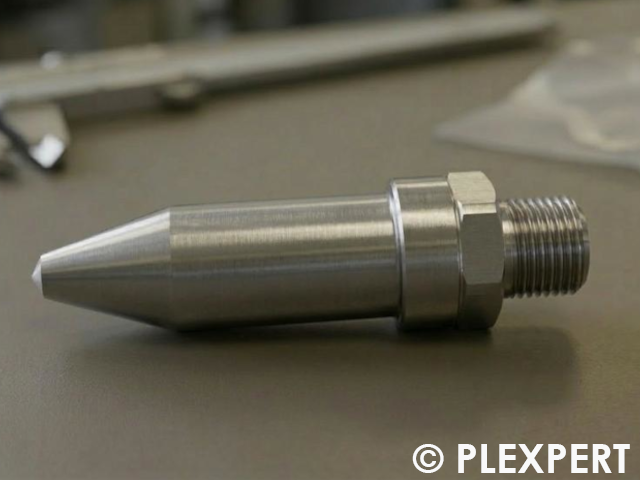
Quality Assurance: Conical
indenter for screwing into a
hardness tester
Related topics:
Instrumented penetration testing
Penetration depth
This glossary of plastic industry is provided by PLEXPERT Canada Inc.
May 10, 2019
One important characteristic to determine the quality for injection molding production is the pressure inside of the cavity.
The pressure can be detected using pressure sensors that measure either directly or indirectly.
An advantage of the indirect sensors is the positioning in the clamping plate of the mold (ejection side).
There is no need for maintanance or removing the sensors if the mold is disassembled for service.
Therefore, the risk of violating the wires of the sensor is more or less zero. Both Sensor and wires are protected by the pressure plate and a stainless steel cover.

Quality:
Pressure sensor for the indirect measurement of the
cavity pressure.
Related topics:
This information and services are provided by:

This glossary of plastic industry is provided by PLEXPERT Canada Inc.