Jun 18, 2019
Handling of parts, mounting elements or modifying existing parts can be done by an industrial robot. It is a machine that can be programmed and used universally according to changing requirements.
In injection molding, industrial robots are used with five or six movable axis.
Their diversity tasks range from the removal of parts out of the cavity up to palatalizing and assembly work.
The increased flexibility compared to standard linear handling units leads to a wide spread of industrial robots in injection molding.
Modern designs feature additional sensors in order to allow the robot to decide what to do in specific situations.
In the best case, a direct cooperation between human and robot (collaborative robot) becomes possible.

Injection molding machine: Robot with six rotating axis removes an injection
molded part.
Related topics:
Handling (linear)
IdD
Sorting
This glossary of plastic industry is provided by PLEXPERT Canada Inc.
Feb 28, 2023
The thermal radiation of objects is found behind the visible red spectrum of light.
This range is called the infrared wavelength range.
Infrared cameras are used to make the temperatures of the “thermal radiation” (wavelength between 1µm and 20µm) visible.
The camera consists of a lens, a spectral filter, the detector (sensor) and appropriate electronics for amplification, linearization and corresponding signal processing.
Infrared cameras are used in many areas, because they allow the measurement of difficult to access or moving objects with short measurement and response times.
During the measurement there is no influence on the object to be measured.
In the field of plastics technology, infrared cameras are used, for example, for testing and monitoring the injection molding process.
Infrared camera for use in manufacturing
Related Topics:
This glossary of plastic industry is provided by PLEXPERT Canada Inc.
Nov 15, 2018
Each object emits a certain amount of radiation depending on its temperature.
The radiation which adjoins the visible light in direction of larger wavelengths is called infrared or thermal radiation.
This type of radiation was discovered in 1800 by William Herschel.
The wavelength of the infrared radiation is in the range of 780 nano-meters to 1 millimeter.
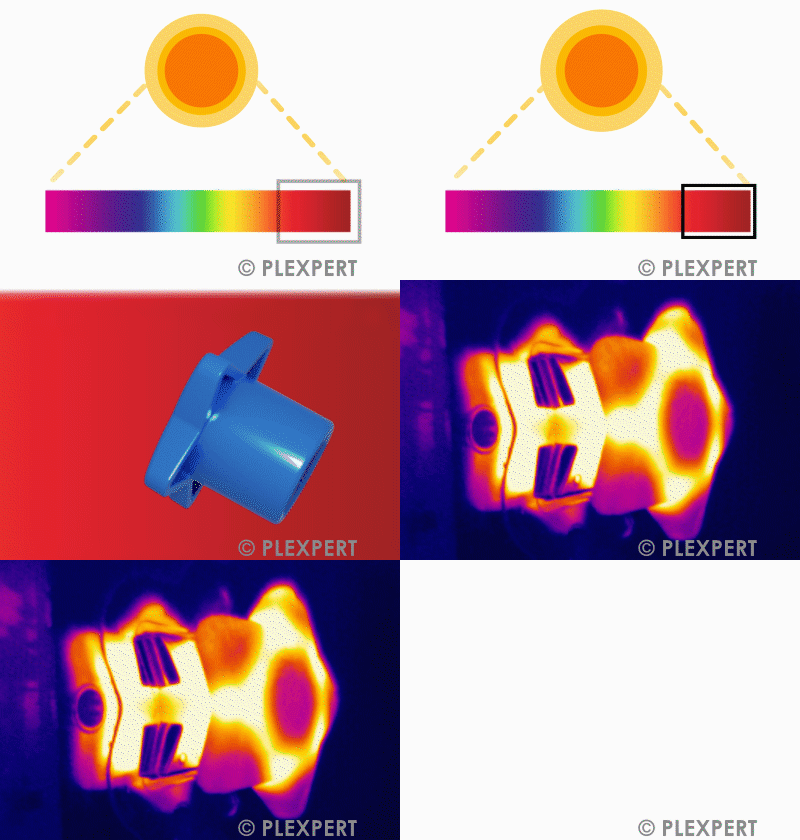
General: The area on the right side of the color bar is called
infrared radiation.
Related Topics:
This glossary of plastic industry is provided by PLEXPERT Canada Inc.
May 25, 2021
Plastics can absorb varying amounts of moisture during storage. Depending on the plastic used, the degree of moisture must be measured before production and reduced by drying if necessary.
If a sample is heated by means of infrared radiation when measuring residual moisture, this is referred to as infrared residual moisture measurement.
The measuring principle is as follows:
A sample is heated by infrared rays. This evaporates the moisture from the plastic. By checking the weight with a precision scale built into the measuring device, the difference in weight before and after drying is determined.
This result corresponds to the moisture content in %.

Quality assurance: Infrared
residual moisture measuring device in use
Related topics:
This information and services are provided by:

This glossary of plastic industry is provided by PLEXPERT Canada Inc.
Aug 22, 2019
The primary molding process mainly used in the plastic industry is injection molding.
With the help of the injection molding machine and the influence of heat, the plastic material is brought to a viscous state.
Subsequently, the melt is injected under pressure into the cavity in the mold.
The shape and surface structure is determined by the geometry of the cavity.
Cooling or cross-linking reaction (for elastomers) solidifies the part and it can be ejected after opening the two mold halves.
The injection molding process is particularly suitable for large quantities.
This is due to the fact of high mold costs which need to be payed proportionally by the produced parts.
Injection molded parts can be used directly after ejection.