Sep 1, 2020
Two cables with same plug type (male plug to male plug and female plug to female plug) cannot be connected directly.
A so called gender changer is used for the connection.
In the inside of the gender changer a side switch takes place, thus the numbers of the pins on both sides stay the same as before.
It is called gender changer as a male plug becomes a female plug with the help of a gender changer and vice versa. An example connection could be a cable of a scale with male plug conected to a gender changer, and this one to PC male plug.

Automation: Gender Changer for DSub9 male to female and DB25 (male/female)
Related topics:
DSub9
DB25
This glossary of plastic industry is provided by PLEXPERT Canada Inc.
Jan 8, 2019
Glass fibers added into the polymer matrix raise the strength and rigidity of a plastic part.
The fibers are oriented during the injection molding process dependent on the melt flow.
The orientation differs over the wall thickness.
At weld lines, the fibers position perpendicular to the flow direction.
The mentioned effects lead to an anisotropic material behavior.
Anisotropy has an essential influence on strength, rigidity, shrinkage and deformation of the part.

Jun 10, 2021
A simple angle measuring instrument or for entering an angle is called goniometer or protractor.
It consists of a circular or semi-circular disc with angular graduation.
The disc is usually made of plastic or sheet metal.
Often goniometers are also integrated in drawing or set squares.
More accurate goniometers have a swivelling rail with a scale with length graduation to milimeters, which can be fixed at the desired angle.
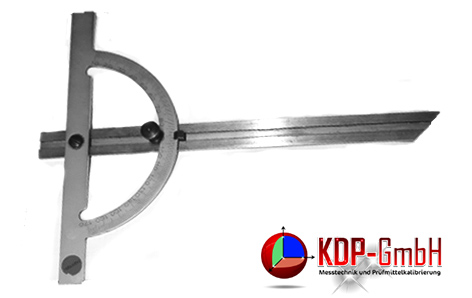
Measuring Technology:
Goniometer with swivelling rail
Related topics:
This information and services are provided by:

This glossary of plastic industry is provided by PLEXPERT Canada Inc.
Feb 8, 2019
A standard injection mold is split into the injection side and the ejection side.
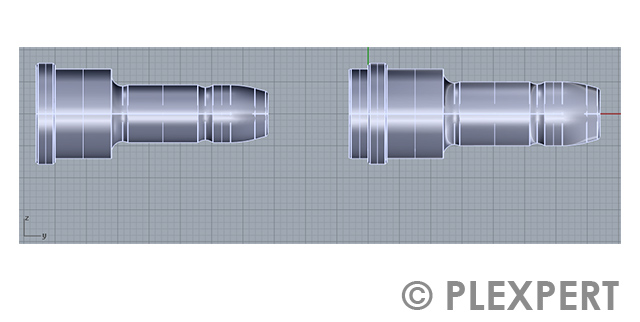
When the mold is closing, the two halves of the mold are centered through the guide pillars.
In most cases, the guide pillars are fixed on the injection side.
The ejection side moves along with the guide pillars till the mold is completely closed.
In order to make the movement of the other half of the mold easier, guide pillars can have oil grooves.
Depending on the mold layout, guide pillars can have a centering collar to increase stability.
Four guide pillars will be used in one mold.
It has to be noted that the diameter of the guide pillars varies.
Three of them have the same diameter, one of them has a different one.
This is to make sure the mold cannot be mounted in the wrong way.
Apr 8, 2019
In two shot molding, the first component is commonly robust and gives the shape of the geometry.
Therefore, it is also called the hard component.
Its rigidity leads to the main influence for the warpage.
Typically, its materials are PP, PS or PC+ABS.