Mar 8, 2022
A process where a physical or chemical blowing agent is solved into the polymer melt, which leads to the melt foaming and expanding in the cavity.
Due to the gas expansion of the blowing agent, the injected part will have a sandwich structure with a foamed core and compact skin layers.
The gas pressure inside the part can shorten or completely substitute the holding phase of the injection process, which leads to shorter cycle times.
With this process, part properties such as lesser warpage as well as part weight reduction can be realized. With process-optimized part design, part weight reductions and material savings of up to 35% have been realized.
Chemical blowing agents are usually added to plastics as a masterbatch and decompose into blowing gases and solid by-products under heat.
For the metering and mixing of physical blowing agents, such as nitrogen or carbon dioxide, additional equipment and a special screw are required.

Injection Molding: Schematic
plasticizing unit with special equipment for the introduction of physical blowing agents for foam
injection molding (© Yizumi Germany GmbH)
Related topics:
This information and services are provided by:

This glossary of plastic industry is provided by PLEXPERT Canada Inc.
Jan 25, 2019
No further melt can enter the cavity of the injection mold after the smallest diameter of the cold runner freezes off.
This duration is called freeze time and represents the theoretically maximum packing time.
While increasing the packing time stepwise it is possible to find out the freeze time by taking the weight of the parts. As soon as the weight stays the same, the cold runner is frozen.
In the simulation the freeze temperature in this area or the flow rate help additionally.

Apr 19, 2019
In the injection molding, the melt is injected inside the cavity through a gate.
Therefore, the gate position has an essential influence on the quality of the part.
The route of weld lines, the existence of air traps and the fiber orientation depends on the gate position.
Different flow length affects the pressure that is needed to fill the cavity.
The wall thickness at gate position leads to a longer or shorter packing time.
Moreover, the gate position might change the warpage of a part considerably.
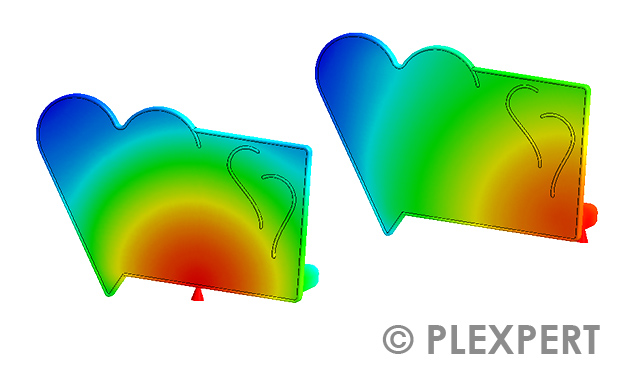
Injection
mold: Filling pattern on the same
part with two different gate locations.
Related topics:
This glossary of plastic industry is provided by PLEXPERT Canada Inc.
Feb 28, 2020
Checking and calibrating measuring instruments and test equipment can be done with a gauge block.
A gauge block is made of steel, carbide or ceramic.
They can be used as secondary standards for direct measurement.
Each gauge block embody a certain length with a high accuracy.
If needed several blocks can be combined in order to create any dimension that need to be measured.
Gauge Blocks are available in various forms like parallel, angular, spherical or cylindrical.

Measuring Technology:
Gauge Block to calibrate measuring instruments.
Related topics:
This information and services are provided by:

This glossary of plastic industry is provided by PLEXPERT Canada Inc.