Sep 12, 2023
Innovative ideas, products and services are still mainly presented at industry-specific trade fairs.
These fairs are organised in the region or supra-regionally.
In the past, trade fairs were used to request information about specific products from several manufacturers who were on site at the trade fair.
Today, this information must be available immediately.
Search engines on the Internet show many results for queries, which often have to be evaluated laboriously.
The Kunststoffmesse24.de platform has been set up to bundle industry-specific information and keep it permanently available.
This gives companies a further presence on the Internet with backlinks and marketing posts in the social media in addition to their homepage.
Access to Kunststoffmesse24 is permanently available around the clock.
General: Lobby Kunststoffmesse24
General: Kunststoffmesse24
Related Topics:
This glossary of plastic industry is provided by PLEXPERT Canada Inc.
Nov 23, 2021
The length of the screw is specified exclusively in relation to the screw diameter.
Doing it like that allows to compare different screws much better.
The process-engineering effective length of the screw is specified as L.
This value represents the distance the granules/melt travels along the screw.
For the determination, the length from the front edge of the hopper to the backflow barrier is always used.
The effective length is set in relation to the diameter D of the screw.

Aug 5, 2019
The flow behavior of a fluid is described by its type of movement.
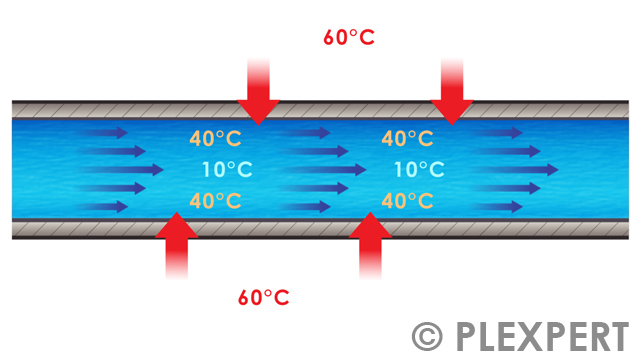
A straight forward movement in separated layers with equal temperatures is called laminar flow.
A tube with Reynolds number lower than approximately 4000 will have this kind of flow behavior.
A coolant in injection molding with laminar flow will have its highest temperature near the mold wall.
The lowest temperatures will be found in the center of the cooling channel.
The fluid is heating up from the outside to the inside.
The mold will no longer cool down as soon as the outer layer of the coolant has absorbed the maximum amount of heat.
Because of the laminar flow there is no temperature exchange within the coolant.
The outer layer of the coolant stays hot.
This means that the coolant cannot sufficiently cool the mold anymore.
Therefore, laminar flow is not recommended for a coolant.
Sep 22, 2019
With a share of nearly 15 % polyethylene is considered a mass plastic resin.
However, there are different polyethylene (PE)-types available.
One of them is called LDPE, where LD stands for low density.
In its molecular structure, the high branched polymer chains lead to a low density between 0.915g/cm³ and 0.935 g/cm³.
Through the material’s flexibility and corrosion resistance, it can be used in many ways.
As an example, LDPE is used for the production of different containers, but most commonly for plastic bags.
In juice or milk cartons LDPE is needed as barrier film for waterproof.
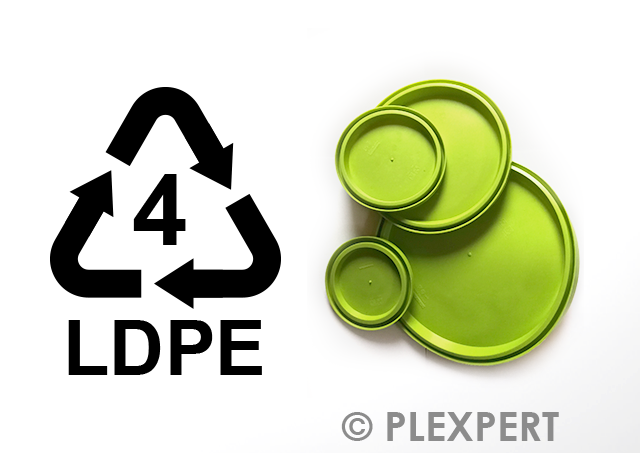
Plastic: Lid out of
LDPE for the usage in the kitchen.
Related topics:
This glossary of plastic industry is provided by PLEXPERT Canada Inc.
Feb 18, 2025
After the mold is built it must be checked whether the cooling system of a mold is sealed and working properly. This test is called Leak tightness test. The temperature control circuit is examined for leaks to ensure that no cooling fluid escapes and that heat transfer remains efficient. Common testing methods include pressure testing with air or water as well as leak detection using specialized test fluids. Leaky temperature control circuits can lead to uneven cooling, increased scrap rates, and production disruptions. Regular leak tightness tests help prevent mold damage and ensure consistent part quality. Especially in high-precision applications, flawless temperature control is crucial for maintaining dimensional accuracy in injection-molded parts.

Quality:
Leak test of a circuit with hand pump
Related topics:
This glossary of plastic industry is provided by PLEXPERT Canada Inc.