Nov 16, 2021
Digitalization is one of the most important topics in modern industry.
A key buzzword in this context is IoT (Internet of Things).
The term was coined by Mark Weiser in 1991 and describes the link between physical and virtual objects.
The communication of the individual objects with each other via a central network is essential in this concept.
The aim is to structure production processes and make them more efficient.
Possible problems are to be detected at an early stage in order to ideally take automated countermeasures.

Automation Technology: Network of different object exchanging data with each other
Related topics:
DiagBes
This glossary of plastic industry is provided by PLEXPERT Canada Inc.
Sep 10, 2020
Temperature plays the most important role if it comes to injection molding.
Before the part is ejected it is good practice to analyse the temperature distribution on the surface.
This is where IR-ThermalSystem comes into play.
It consists of an infrared camera, a magnetic stand, cables some electronic device and a specialized software (called IRDAS), that records
all the critical information from one shot to another.
The system used for quality control, supports a centralized database and can be connected to several other
products that are useful in the injection molding process.
This includes DiagBes as well as Xscale and Xmold.
Evaluating temperature helps to identify short shot and flashing as well as proper functionining of the cooling channels.
Dec 27, 2018
When the material enters a larger cavity with a high flow rate jetting might occur.
While the melt doesn’t hit a wall, a snake-like cord is build until a wall is reached.
The cooling down of the cord surface prevents a good merging between the cord and the new entering melt.
This leads to a reduction of the stiffness and a visible mark.
Slow injection or a bulging wall directly behind the gate will prevent the jetting effect.

Mar 19, 2026
Heat is generated by the electrical resistance of a conductor when an electric current flows through it. This physical principle is used in plastics processing to heat components such as barrels, tools, or heating plates in a controlled manner. Electrical heating elements convert electrical energy directly into thermal energy, bringing process components to the temperatures required for melting or conditioning plastics. The method enables precise temperature control and is therefore widely used in equipment such as extruders and injection molding machines.
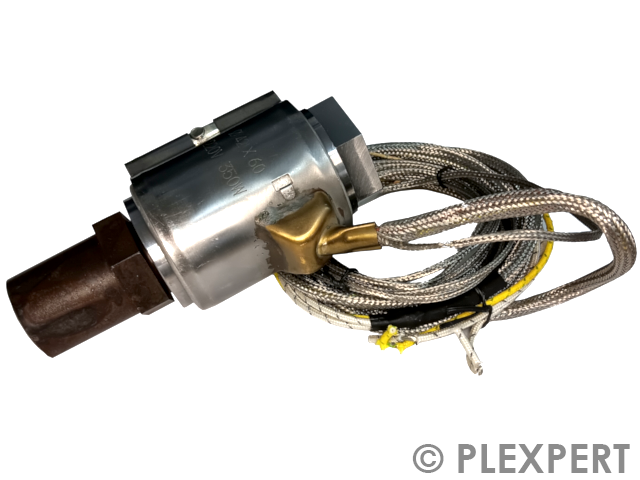
Injection molding process: Heating tape in the area of the machine nozzle, serving as a Joule heater
Related topics:
Extrusion
This glossary of plastic industry is provided by PLEXPERT Canada Inc.
Oct 11, 2019
The international trade fair for the plastic and rubber industry, called K-Show, takes place every three years since 1952.
More than 3000 exhibitors from more than 60 nations present their products and services during 8 days in Düsseldorf, Germany.
This makes the K-Show the worldwide largest trade fair for the plastic industry.
The products range from raw materials and auxiliaries, machinery and equipment, semi-finished products, technical parts and reinforced plastics to services regarding all other topics about plastic.
Other name: K trade show

General: Logo of the K-Show.
Related topics:
This glossary of plastic industry is provided by PLEXPERT Canada Inc.