Oct 23, 2019
After an injection mold is finished it will get its rating plate.
There is no design of the rating plate generally admitted.
Very often rating plates are created based on factory standards and provided to the mold maker by the future owner of a mold.
There are different online portals available, where rating plates for injection molds can be ordered.
The most common entries are asked for in standard forms.
Often a D&B D-U-N-S® number is requested on the plate besides the name of the mold, the manufacturing date, the size of the mold and its weight.
This number is specific for a given supplier and is used to prevent unjustified passing of the tools to third parties.
The extent to which CE marking is required for tools has not yet been conclusively clarified.
It has to be noted that type plates have to be fixed on the mold and shall not be removable in order to secure the ownership of the mold.

Injection Molding: Two different rating plates on one
mold
Related topics:
This information and services are provided by:

This glossary of plastic industry is provided by PLEXPERT Canada Inc.
Oct 7, 2019
Molding compounds that contain fully or partly components that have already been been subjected to a processing process for the final product such as semi-finished products, finished parts or sprues have the generic term recyclates.
The name recyclate is a combination of the words recycling and the suffix of many plastics (for example acrylate).
A recyclate may refer to: regrind, regranulate or compound.
Recyclates are no prime material but can substitute prime material in several applications and save CO2 emissions.

Plastic: Power drill housing produced out of
recyclate material.
Related topics:
This information and services are provided by:

This glossary of plastic industry is provided by PLEXPERT Canada Inc.
Oct 7, 2019
With the recycling of industrial production waste, i.e. sorted sprues or rejects are collected, grinded and reprocessed. The reprocessing is a melting process for the production of granules with constant particle size. Without using additives a regranulate is produced, by using additives, i.e. to match specified mechanical properties, a compound is produced. This new regranulate or compound can be used the same way as prime material and is retuned to the circulation. The use of recyclates versus prime material also reduces CO2 emissions, i.e. Polyamide more than 7 kg CO2 emissions per used kilogramm recycled material instead of prime and thus makes an important contribution to environmental protection.
The mechanical recycling of household waste works in principle the same way with additional step of pre sorting one ore more cleaning steps. So collecting, sorting, shredding, wet grinding or washing and reprocessing by melt filtration. Du to impurities of the input raw material, the yield of recyclable granules is much lower.

Plastic: Collected sprues for the mechanical
Recycling.
Related topics:
This information and services are provided by:
This glossary of plastic industry is provided by PLEXPERT Canada Inc.
Jan 10, 2019
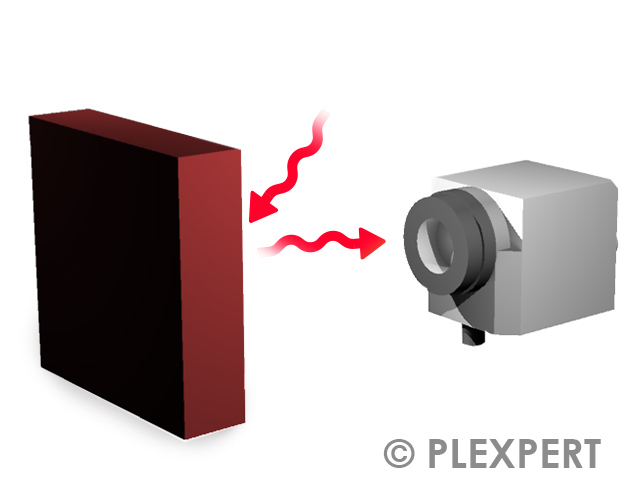
The ability of an object to mirror infrared radiation is called reflexion.
The amount of the reflected radiation depends on the surface of a given object.
Plastics have usually a low amount, while shining metals (for example an insert in an injection mold) have a high amount of reflexion.
The higher the proportion of reflexion, the more difficult it is to measure temperature using an infrared camera.
Oct 14, 2019
By processing regrind via a melting process (Compounding) and adding additives compound (regenerate) is obtained.
The additives are used for example to specifically define the mechanical properties of the material.
The Regenerate (Compound) has, like the regranulate, a uniform particle size and no dust content.
Therefore the material can easily be reused for the production of injection moulding components.

Plastic:
Additives are added for producing a
compound
Related topics:
This information and services are provided by:
This glossary of plastic industry is provided by PLEXPERT Canada Inc.