Oct 14, 2019
Granule is obtained by processing regrind via a melting process (Compounding).
Reused plastic is used for this process, giving it the correct name “Regranulate”.
The particle size is uniform.
In contrast to the regrind there is no dust content in the regranulate.
Therefore it can be easily reused for the production of injection moulding components.

Plastic: Regranulate and tensile samples made therefrom
Related topics:
This information and services are provided by:

This glossary of plastic industry is provided by PLEXPERT Canada Inc.
Oct 7, 2019
During production of thermoplast materials wasted, like sprues and rejects can be reprocessed.
Grinding these plastic parts leads to the so called regrind.
Depending on the grinding process the regrind has different and irregular particle sizes from 6 mm to 8 mm.
During production of new plastic parts a variable quantity of regrind can be mixed with new material.
It has to be noted that the dust content can cause problems in production.

Plastic:
Regrind
Related topics:
This information and services are provided by:
This glossary of plastic industry is provided by PLEXPERT Canada Inc.
Mar 24, 2026
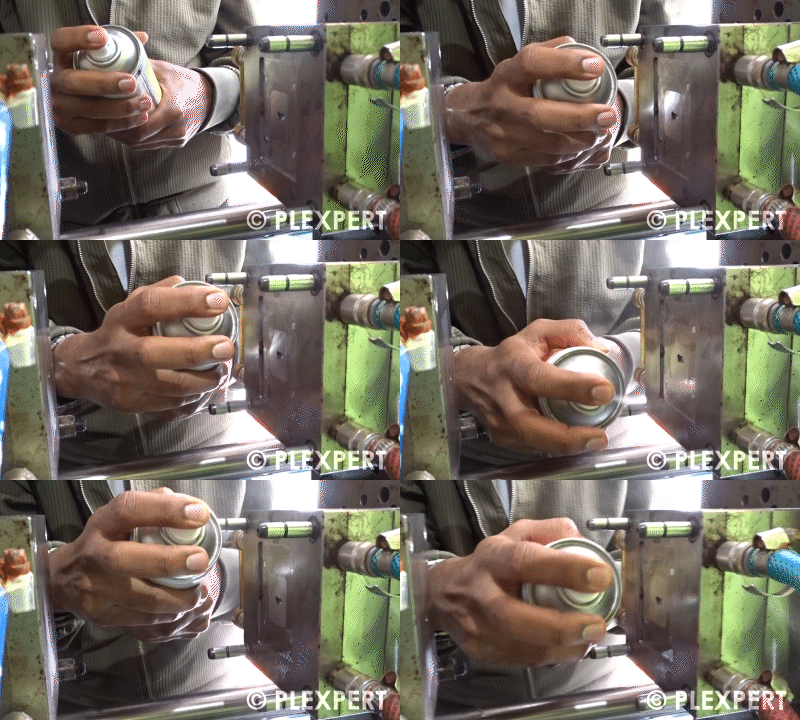
This term refers to an auxiliary substance used in plastics processing to prevent a molded part from adhering to the surface of the mold. By applying this substance to the mold surfaces, the demolding of plastic parts becomes easier and the risk of damage or surface defects is reduced. Such agents are particularly used in processes such as injection molding, compression molding, or laminating. They can be applied as a spray, liquid, or solid coating and form a thin separating layer between the mold and the plastic material. This supports a reliable and consistent demolding process.
Feb 20, 2025
The duration that the plastic melt takes to travel from the plasticizing unit to the cavity of an injection mold is called residence time.
It is influenced by the size of the hot runner relative to the part, as well as by the cylinder volume and shot weight. A long residence time can occur when a large cylinder is used for small shot weights, potentially leading to thermal degradation of the material. If the residence time is too short, incompletely melted or unprocessed material may enter the cavity. An optimal residence time is crucial for part quality, ensuring uniform material processing and stable production. Excessive temperatures and shear stresses during prolonged residence times can cause material degradation, discoloration, or mechanical weakening. Precisely adjusting the residence time is therefore essential for maintaining the quality and durability of plastic components.

Plastic: Schematic representation of the path for the plastic from the
hopper to the
cavity
Related topics:
This glossary of plastic industry is provided by PLEXPERT Canada Inc.
Nov 29, 2018
The injection mold is usually temperated during the complete cycle.
The time from the end of packing phase until ejection is called residual cooling time (blue line in the time-pressure diagram below).
During this time the cooling of the part takes place solely.