Sep 30, 2019
Inspections in the area of incoming goods and in the production are useful measures for quality assurance.
The exact procedure of the needed quality checks are defined in a list, the so called test plan.
Hereby the specification of the attributes (= what should be checked?), as well as the scope of testing (= how much should be tested?) is determined. Furthermore the test plan declares the time frame (= how often to check?) and the test equipment (= which device has to be used?).
If software based, known errors can be recorded in the test plan and measures defined to show what need to be done if defects appear.
The test plan provides, especially by adding descriptions and pictures, a comprehensive procedure to detect and respond to errors that might occured.

Quality: Example of a test plan of the system „solvtec
CAQ“
Related topics:
This information and services are provided by:

This glossary of plastic industry is provided by PLEXPERT Canada Inc.
Oct 14, 2025
Standardized specimens made of plastic are used to determine material properties and are referred to as test specimens. They are produced in defined shapes and dimensions to ensure reproducible and comparable measurement results. These specimens are used to test mechanical, thermal, and chemical properties such as tensile strength, impact resistance, and heat deflection temperature. Their geometry and size depend on the specific test method and applicable standards such as DIN, ISO, or ASTM. The use of standardized test specimens enables precise quality control and supports material development in plastics engineering.
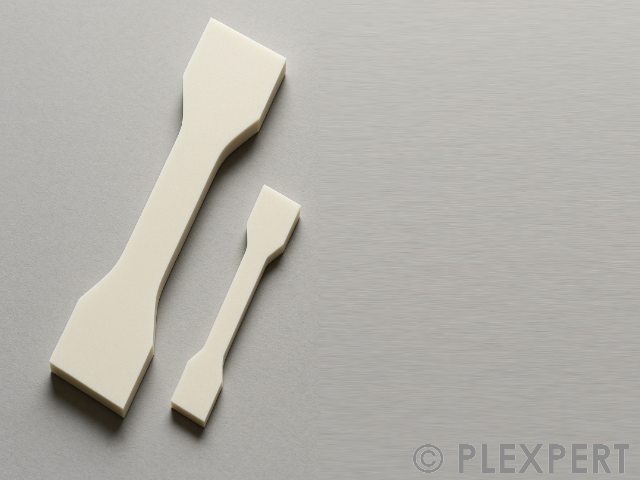
Small and large tensile bar
Related topics:
Impact resistance
This glossary of plastic industry is provided by PLEXPERT Canada Inc.
Nov 27, 2019

Measuring Technology:
Testing pin made out of special tool steel
Related topics:
This information and services are provided by:

This glossary of plastic industry is provided by PLEXPERT Canada Inc.
Mar 8, 2019
A pyramid-like 3D-object, with 4 triangle elements is called tetrahedron (Tetrahedral Element).
In simulation tetrahedrons are used to build a volume mesh.
In a first step the surface of a part will be meshed using triangle elements.
The triangle elements will be used as a base for the first layer of tetrahedrons going into the part.
Depending on the size and orientation of the base triangle element tetrahedrons with a critical aspect ratio can be created.
The random orientation of a tetrahedron elements lead to a not preferred direction.
This can lead to longer computation times.

Simulation: A pyramid-like 3D- object – called
tetrahedron (
Tetrahedral Element).
Related topics:
Volume Mesh
Surface Model
This glossary of plastic industry is provided by PLEXPERT Canada Inc.
Jul 16, 2019
Heat can be described physically as oscillation of the molecules.
An excessive oscillation can impact the molecules of plastic drastically.
The effect of it is called thermal impact.
In the worst case, the molecules can break: the molecules degrade.
This is a damage of the plastic, which increases the higher the prevailing temperature.
Furthermore, the duration of the temperature effect – in injection molding called residence time – plays an important role.
An example from the daily life is the sunburn.
Here again, the two factors temperature and residence time are responsible for the thermal impact.

Injection Molding Defect: The longer and the higher the
thermal impact of a body, the darker it will get (Example: Vegetable).
Related topics:
This information and information services are provided by:

This glossary of plastic industry is provided by PLEXPERT Canada Inc.