Jul 4, 2019
The name compression chiller refers often to system cooler.
In the injection molding industry, they are used to draw the thermal energy from the coolant.
Cooling channels use the coolant with a lower temperature, for example, to regulate the flow temperature.
In a system cooler, the consumption water is actively cooled by compression.
The usual temperatures in industrial/plastic application are in between 5 °C to 25 °C.
System coolers are divided into:
1. Air cooled:
In the air-cooled version, the waste heat (condenser energy) is released into the ambient air. The advantage here is that the system cooler works independently, without on-site cooling network.
2. Water-based:
In the case of water-based chillers, the warm water is returned to an on-site water cycle (domestic water, well or river water).
Image 1: System cooler as small as tabletop unit type SC..K
Image 2: Temperature Control: Floor model type SC..S.
Related topics:
This information and services are provided by:

This glossary of plastic industry is provided by PLEXPERT Canada Inc.
Jan 10, 2019
The injection molding process highly depends on temperature.
If the molten plastic enters the cavity the temperature is high and sequentially decreasing overtime.
The reduction in temperature is based on the given cooling layout of the mold and the process parameters set.
In simulation the temperature result shows temperature distribution of the part and mold at current instant.
It can help to evaluate temperature related aspects of the process, for instance, hot spot.

Feb 20, 2024
In the plastics industry, a specific heat treatment process is essential to improve the performance and quality of injection-molded components.
This process, which is applied after injection molding, involves carefully heating the plastic parts to a precise temperature,
followed by a controlled cooling process.
The aim is to relieve internal stresses within the parts that can arise during the injection molding process.
This treatment not only improves the physical properties of the plastic products, such as flexibility and impact resistance,
but also increases their resistance to environmental influences and mechanical stresses.
The result is a significant increase in product quality and durability, which is beneficial for manufacturers and end users alike.

Mar 30, 2023
A tensile test on plastics is a test procedure used to determine the mechanical properties of plastics.
In this test method, a sample of the plastic is clamped in a testing machine and subjected to a tensile force under controlled conditions.
During the tensile test, various parameters are measured, including the load, strain and stress of the plastic.
These parameters are used to determine the elasticity, strength and toughness of the material.
The results of tensile testing can help optimize material design by providing information about the properties of the plastic that are important for the specific
application.
Tensile testing is used in various industries such as automotive, aerospace, electronics and medical to evaluate the quality and reliability of
of plastic parts and components.


Measuring Technology: Tensile Testing1
Measuring Technology: Tensile testing2
Related topics:
This information and services are provided by:

This glossary of plastic industry is provided by PLEXPERT Canada Inc.
Sep 22, 2019
Measuring and testing devices are necessary in productino to monitor the quality of the parts.
Often there are many different testing equipments used within a company. They need to be controlled regarding suitability and long-lasting performance. This includes regular calibration of the testing device.
All testing devices can be cataloged and recorded in detail with the help of a software-aided test euqipment administration. Here the calibration dates shall be entered and monitored.
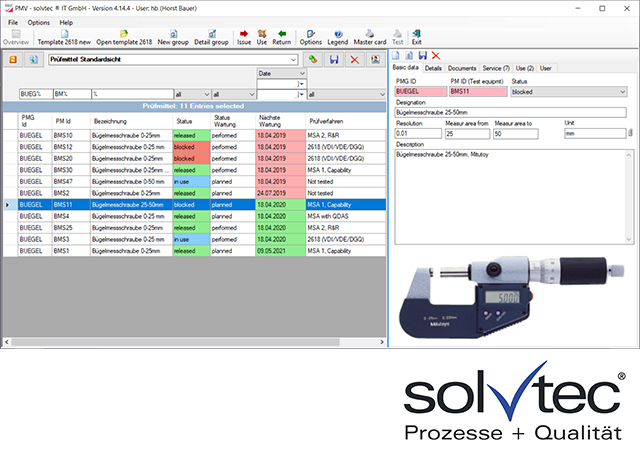
Quality: Example of the test equipment overview from the
Test equipment administration in “solvtec
CAQ”.
Related topics:
TOPIC1
TOPIC2
TOPIC3
This information and services are provided by:

This glossary of plastic industry is provided by PLEXPERT Canada Inc.