Mar 19, 2026
This term describes the formation of fine cracks in plastics caused by the combined action of mechanical stress and certain environmental media. The cracks often occur without significant external load when the material is already subjected to internal stresses, for example due to processing or assembly. Chemical influences such as solvents, cleaning agents, or oils can further accelerate this process. In plastics engineering, this phenomenon is a common cause of failure because it can lead to brittle fracture of the component. Prevention includes proper material selection, low-stress processing, and suitable operating conditions.
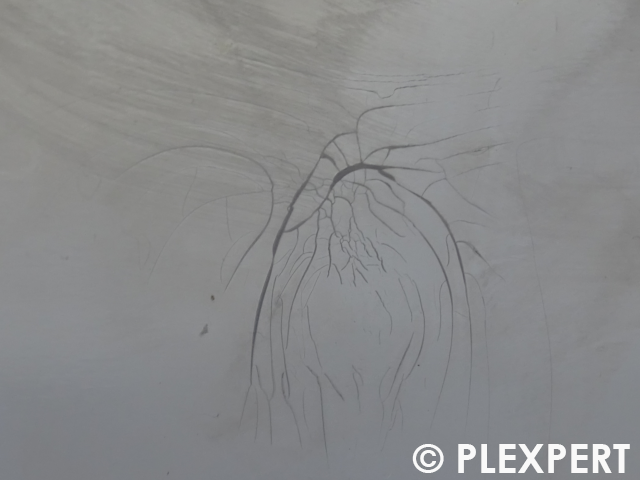
Quality: Stress cracks in a
polystyrene moulded
part
Related topics:
Stress corrosion cracking
Internal stress
Environmental stress cracking
This glossary of plastic industry is provided by PLEXPERT Canada Inc.
Apr 12, 2019
In the injection molding process, it is important that the ejection force does not lead to any deformation of the plastic part.
A stripper plate is distributing the applied demolding force from the machine homogeneously along the contact surface and keep the molded part in a defined position during ejection.
Damage of the part as well as marks on the part will be avoided in this way.
Preferably for parts with a deep core, this method is used.
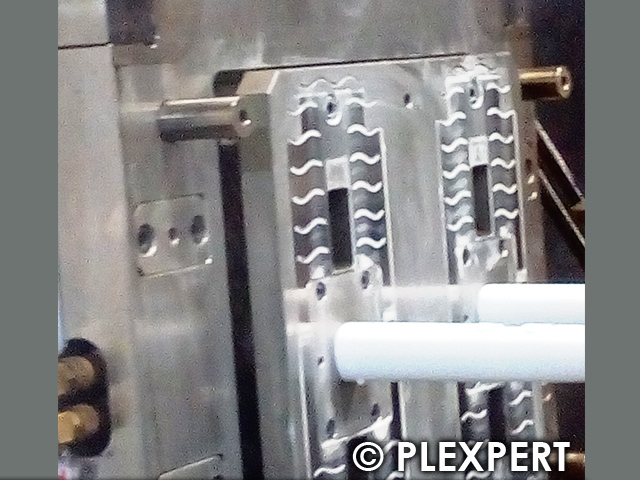
Injection
mold: The
stripper plate pushes the
part homogeneously out of the
mold.
Related topics:
Tool Design
This glossary of plastic industry is provided by PLEXPERT Canada Inc.
Mar 8, 2019
For a 2.5D injection molding simulation a surface mesh is needed.
All surfaces of the chosen CAD model will be covered with triangle elements to build a closed mesh.
A surface mesh can be generated automatically with a CAD-System by exporting it as stl-file. This format is often used in rapid prototyping processes.
But the quality of such a mesh is not accurate enough for an injection molding simulation.
The mesh carries the geometry information and need to be optimized.
It is important to have a high amount of elements as well as to make sure that each element has a good aspect ratio.

Simulation: The prepared mesh for the usage in the next simulation.
Related topics:
This glossary of plastic industry is provided by PLEXPERT Canada Inc.
Sep 10, 2024
All processes that deal with the examination and evaluation of the surface quality of plastics are summarized in surface testing technology.
Surface testing technology is used to assess the quality and suitability of plastics for specific applications.
The most important methods include optical inspections, roughness measurements, contact angle measurements and microscopy, which can reveal defects such as cracks, scratches or uneven coatings.
These test methods help to characterize the surface structure and properties such as gloss, adhesion and wettability.
Surface testing technology is crucial for quality assurance and contributes to the optimization of manufacturing processes and product designs. It is particularly important in applications where the surface quality significantly influences the functionality and aesthetics of the end product. Targeted surface testing allows defects to be detected and corrected at an early stage, which increases the durability and reliability of plastic products.

Quality: Stress cracks after wetting the surface with a solvent
Related topics:
Plastic testing
Youngs´s modulus
This glossary of plastic industry is provided by PLEXPERT Canada Inc.
Dec 9, 2021
The symbol for the location tolerance symmetry is used to describe a tolerance zone on technical drawings.
This is bounded by two planes symmetrical to the specified reference axis.
The distance between these planes is indicated together with the symbol on the drawing. The same applies to the reference axis.
Measured values on the toleranced center plane must lie between the parallel planes.

Quality Assurance: The measured values of the center plane of the groove must be within two surfaces 0.07mm apart
Related topics:
This glossary of plastic industry is provided by PLEXPERT Canada Inc.