Feb 26, 2026
A structured transfer of simulation-relevant data throughout the entire injection molding process chain is enabled by a specially developed file format with the extension .pxs. This format functions as a dynamic data container that consolidates results from rheological calculations, structural analyses, and material and machine data. Thanks to its flexible structure, it can be loaded by various software tools and machines, each extracting only the information required for the respective process step. As a result, the format ensures consistent and automated data flow from part and mold design to production and quality assurance. At the same time, it provides a foundation for increasingly autonomous manufacturing workflows in injection molding.
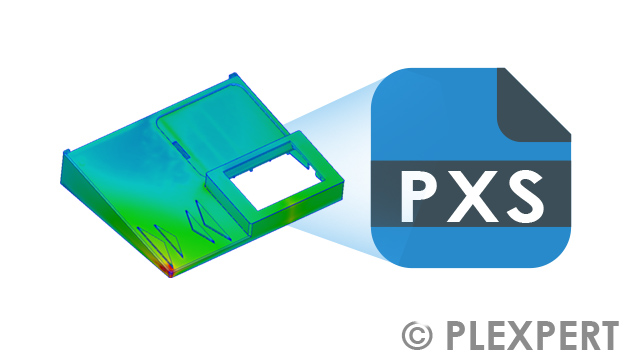
Illustration
Related topics:
Digital process chain
This glossary of plastic industry is provided by PLEXPERT Canada Inc.
Mar 5, 2024
Computers communicate in the LAN via Ethernet connections. The cables used have RJ45 plugs for connection to hubs or switches.
The RJ45 plug is a standard plug and consists of eight pins, each of which is assigned to a pair of wires in an Ethernet cable.
The RJ45 socket receives the RJ45 plug and forms a physical connection between the Ethernet cable and the device,
creating an electrical connection.
The RJ45 connection enables the transfer of data via the Ethernet cable between different network devices.
This can be the connection between a computer and a router for Internet access, between computers in a local network or between a computer and a network printer.
RJ45 plugs and sockets serve as the basic building blocks for computer network cabling and are crucial for reliable data transmission in these networks.
Automation technology:
RJ45 plug
Automation technology:
RJ45 socket
Related Topics:
This glossary of plastic industry is provided by PLEXPERT Canada Inc.
Oct 13, 2020
In order to standardize serial communication between different devices the Electronic Industries Association (EIA) defined in 1960 the Recommended Standard 232 (or in short RS232).
RS232 is often referred to as serial interface although other serial interfaces do exist.
The standard of RS232 defines the timing and the voltage level used in a connection between a terminal and a modem.
Originally a 25pol DSub connector was suggested to be used in order to connect devices with each other.
However, soon 9pol DSub connectors where used as well.
RS232 does not define a protocol that shall be implemented but the way transmission shall technically be done.
In communication two data cables are used called TxD (transmission) and RxD (receive) in combination with a third line for ground (GND).
A logically 0 is represented by a voltage between +3 V and +15 V, while a logically 1 is represented by -3 V to -15 V.
The data transmission is done using a certain number of bits, which carry ASCII control codes with determined start and end of each transmission.

One word represented by bits transmitted using
RS232
Related topics:
DB25
Xscale
This glossary of plastic industry is provided by PLEXPERT Canada Inc.
Sep 19, 2024
There are a variety of interfaces and protocols for exchanging data between different devices.
RS485 describes a device that enables communication via the RS485 standard.
This is a serial communication that is frequently used in industrial applications (automation technology, building management systems, etc.).
RS485 enables reliable data transmission over longer distances and in environments with a high susceptibility to electrical interference.
The adapter converts the signals between the RS485 interface and another interface, such as USB or RS232, so that a connection to computers or control systems can be established.
RS485 allows several devices to communicate simultaneously on one bus (half-duplex or full-duplex).
Using the RS485 adapter makes it easier to connect modern devices to older or specialized systems.


Automation technology:
RS485 adapter – connector with terminals
Automation technology:
RS485 adapter with connector
plug to a USB port
Related Topics:
This glossary of plastic industry is provided by PLEXPERT Canada Inc.
Mar 2, 2020
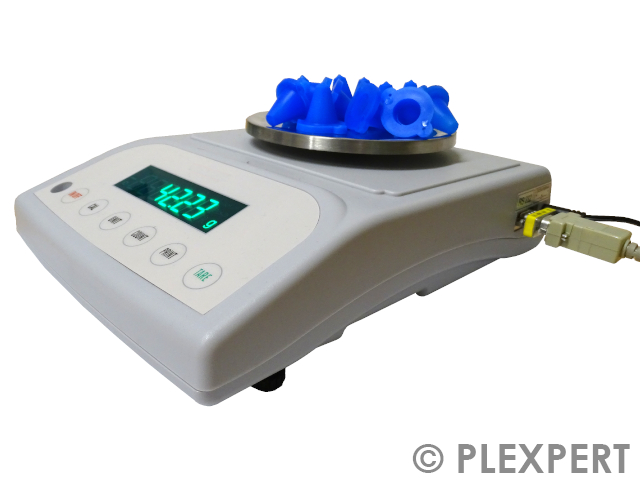
If we want to know how much something weighs we need to determine its weight using a special measuring device called scale.
Historically the first scale was only a simple beam with two strings on each side and a plate attached to each string.
To determine the weight on one side, parts with a known and defined weight where put on the other side as long until the beam comes back into a horizontal position.
Nowadays we use mechanical or electronic scales.
The later converts the weight into a deformation, that can be tracked by a strain gauge and hence leads to a voltage difference.