Sep 30, 2019
Inspections in the area of incoming goods and in the production are useful measures for quality assurance.
The exact procedure of the needed quality checks are defined in a list, the so called test plan.
Hereby the specification of the attributes (= what should be checked?), as well as the scope of testing (= how much should be tested?) is determined. Furthermore the test plan declares the time frame (= how often to check?) and the test equipment (= which device has to be used?).
If software based, known errors can be recorded in the test plan and measures defined to show what need to be done if defects appear.
The test plan provides, especially by adding descriptions and pictures, a comprehensive procedure to detect and respond to errors that might occured.

Quality: Example of a test plan of the system „solvtec
CAQ“
Related topics:
This information and services are provided by:

This glossary of plastic industry is provided by PLEXPERT Canada Inc.
Oct 14, 2025
Standardized specimens made of plastic are used to determine material properties and are referred to as test specimens. They are produced in defined shapes and dimensions to ensure reproducible and comparable measurement results. These specimens are used to test mechanical, thermal, and chemical properties such as tensile strength, impact resistance, and heat deflection temperature. Their geometry and size depend on the specific test method and applicable standards such as DIN, ISO, or ASTM. The use of standardized test specimens enables precise quality control and supports material development in plastics engineering.
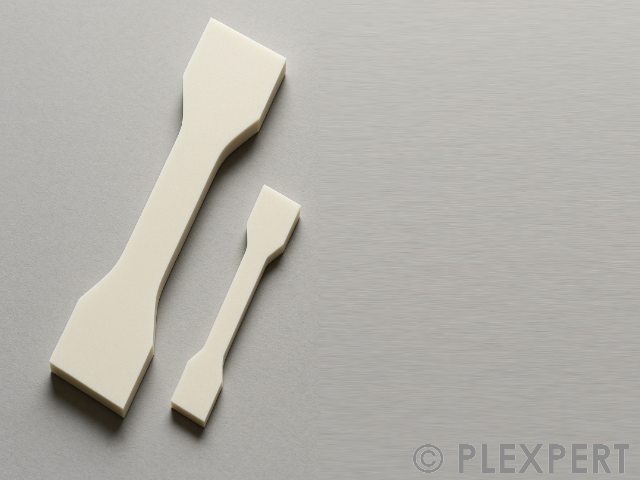
Small and large tensile bar
Related topics:
Impact resistance
This glossary of plastic industry is provided by PLEXPERT Canada Inc.
Dec 9, 2021
This geometric tolerance describes the radial deviation of a target feature when the target is rotated around an axis or straight line.
The specification of a reference point is always required.
A distinction is made between total runout (radial) and total runout (axial):
Total runout (radial) = total runout tolerance.
In this case, the tolerance zone is limited by two coaxial cylinders which are at a specified distance from each other and parallel to the specified reference axis.
Total runout (axial) = Total axial runout tolerance
Two parallel planes at a given distance from each other and perpendicular to the reference axis form the tolerance zone.

Quality Assurance: The shell surface has to be between two cylinders with radial distance 0.2mm
Related topics:
This glossary of plastic industry is provided by PLEXPERT Canada Inc.
Nov 5, 2018
In the measuring technology a trigger designates a triggering event or an impulse. In combination with pressure sensors in a mold e.g. start of injection is needed as a trigger signal. With this the pressure curve for one cycle will be recorded. Regarding quality control with IR-ThermalSystem the trigger signal will be given using a limit switch as soon as the mold is completely open.

Jan 11, 2019
A geometrical difference between target and actual geometry is called warpage.
In the plastic industry this is caused by the developing stresses during the process.
Stresses arise due to the different shrinkage degrees in the part.
Varying Cooling rates, Orientation of the molecules, in-mold constraints (limitations for the shrinkage), uneven wall thickness/packing pressure are responsible for the differences.
These effects can cancel each other out or enhance one another.