Dec 2, 2021
In addition to dimensions, technical drawings often contain symbols (symbols) with values.
By this, the tolerance of important geometric properties or relationships is represented. This is used to describe permissible deviations.
The straightness tolerance specifies a maximum deviation of the contour at a certain point of a molded part.
Tolerated elements can be straight lines or axes.
The measured deviation at any point of the real component must not exceed the Tolearnz value displayed together with the symbol.
For a measuring point on a surface toleranced with straightness, it applies that this point must lie within a distance of two straight lines.
The distance between the two straight lines is determined by the specified tolerance value.
In this case, surfaces can be straight in the X-axis even though they are curved along their Y-axis.
The axis of a cylinder may deviate from its position by a specified tolerance value.
This deviation may only be cylindrical and is called ‘straightness tolerance of an axis’.
This drawing entry is regulated in the ISO 1101 standard or, for North America, in the Geometric Product Specification standard ASME Y 14.5.

Quality assurance: Example of the
tolerance specification on a cylinder axis (incl. meaning)
Related topics:
This glossary of plastic industry is provided by PLEXPERT Canada Inc.
Mar 19, 2026
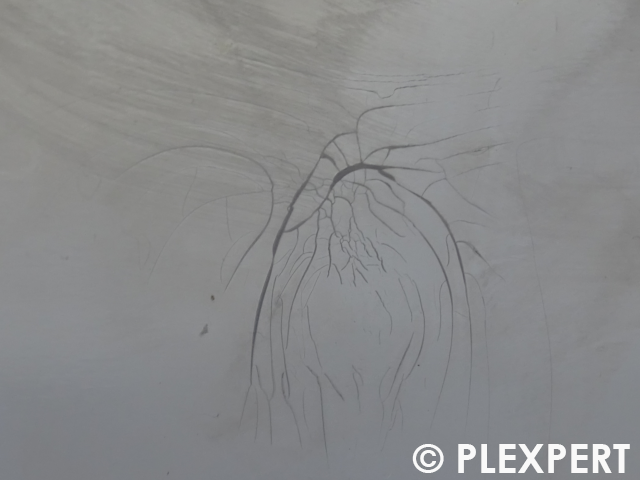
This term describes the formation of fine cracks in plastics caused by the combined action of mechanical stress and certain environmental media. The cracks often occur without significant external load when the material is already subjected to internal stresses, for example due to processing or assembly. Chemical influences such as solvents, cleaning agents, or oils can further accelerate this process. In plastics engineering, this phenomenon is a common cause of failure because it can lead to brittle fracture of the component. Prevention includes proper material selection, low-stress processing, and suitable operating conditions.
Sep 10, 2024
All processes that deal with the examination and evaluation of the surface quality of plastics are summarized in surface testing technology.
Surface testing technology is used to assess the quality and suitability of plastics for specific applications.
The most important methods include optical inspections, roughness measurements, contact angle measurements and microscopy, which can reveal defects such as cracks, scratches or uneven coatings.
These test methods help to characterize the surface structure and properties such as gloss, adhesion and wettability.
Surface testing technology is crucial for quality assurance and contributes to the optimization of manufacturing processes and product designs. It is particularly important in applications where the surface quality significantly influences the functionality and aesthetics of the end product. Targeted surface testing allows defects to be detected and corrected at an early stage, which increases the durability and reliability of plastic products.

Quality:
Stress cracks after wetting the surface with a solvent
Related topics:
Plastic testing
Youngs´s modulus
This glossary of plastic industry is provided by PLEXPERT Canada Inc.
Dec 9, 2021
The symbol for the location tolerance symmetry is used to describe a tolerance zone on technical drawings.
This is bounded by two planes symmetrical to the specified reference axis.
The distance between these planes is indicated together with the symbol on the drawing. The same applies to the reference axis.
Measured values on the toleranced center plane must lie between the parallel planes.

Quality Assurance: The measured values of the center plane of the groove must be within two surfaces 0.07mm apart
Related topics:
This glossary of plastic industry is provided by PLEXPERT Canada Inc.
Sep 22, 2019
Measuring and testing devices are necessary in productino to monitor the quality of the parts.
Often there are many different testing equipments used within a company. They need to be controlled regarding suitability and long-lasting performance. This includes regular calibration of the testing device.
All testing devices can be cataloged and recorded in detail with the help of a software-aided test euqipment administration. Here the calibration dates shall be entered and monitored.
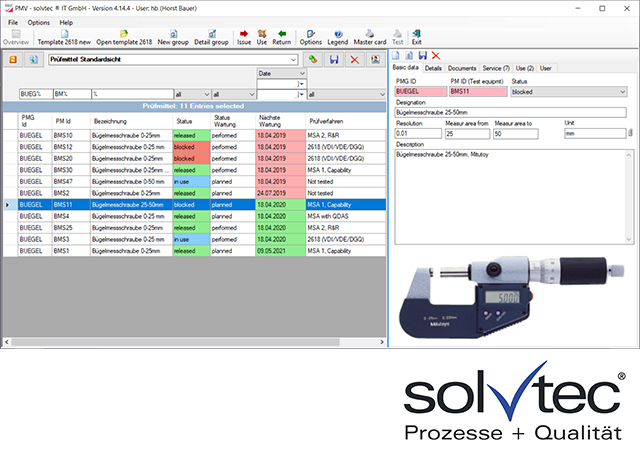
Quality: Example of the test equipment overview from the
Test equipment administration in “solvtec
CAQ”.
Related topics:
TOPIC1
TOPIC2
TOPIC3
This information and services are provided by:

This glossary of plastic industry is provided by PLEXPERT Canada Inc.