Sep 10, 2024
All processes that deal with the examination and evaluation of the surface quality of plastics are summarized in surface testing technology.
Surface testing technology is used to assess the quality and suitability of plastics for specific applications.
The most important methods include optical inspections, roughness measurements, contact angle measurements and microscopy, which can reveal defects such as cracks, scratches or uneven coatings.
These test methods help to characterize the surface structure and properties such as gloss, adhesion and wettability.
Surface testing technology is crucial for quality assurance and contributes to the optimization of manufacturing processes and product designs. It is particularly important in applications where the surface quality significantly influences the functionality and aesthetics of the end product. Targeted surface testing allows defects to be detected and corrected at an early stage, which increases the durability and reliability of plastic products.

Quality: Stress cracks after wetting the surface with a solvent
Related topics:
Plastic testing
Youngs´s modulus
This glossary of plastic industry is provided by PLEXPERT Canada Inc.
Dec 9, 2021
The symbol for the location tolerance symmetry is used to describe a tolerance zone on technical drawings.
This is bounded by two planes symmetrical to the specified reference axis.
The distance between these planes is indicated together with the symbol on the drawing. The same applies to the reference axis.
Measured values on the toleranced center plane must lie between the parallel planes.

Quality Assurance: The measured values of the center plane of the groove must be within two surfaces 0.07mm apart
Related topics:
This glossary of plastic industry is provided by PLEXPERT Canada Inc.
Sep 22, 2019
Measuring and testing devices are necessary in productino to monitor the quality of the parts.
Often there are many different testing equipments used within a company. They need to be controlled regarding suitability and long-lasting performance. This includes regular calibration of the testing device.
All testing devices can be cataloged and recorded in detail with the help of a software-aided test euqipment administration. Here the calibration dates shall be entered and monitored.
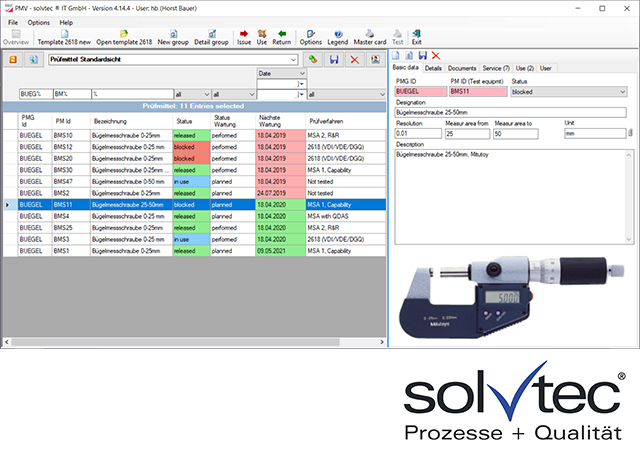
Quality: Example of the test equipment overview from the
Test equipment administration in “solvtec
CAQ”.
Related topics:
TOPIC1
TOPIC2
TOPIC3
This information and services are provided by:

This glossary of plastic industry is provided by PLEXPERT Canada Inc.
Sep 30, 2019
Inspections in the area of incoming goods and in the production are useful measures for quality assurance.
The exact procedure of the needed quality checks are defined in a list, the so called test plan.
Hereby the specification of the attributes (= what should be checked?), as well as the scope of testing (= how much should be tested?) is determined. Furthermore the test plan declares the time frame (= how often to check?) and the test equipment (= which device has to be used?).
If software based, known errors can be recorded in the test plan and measures defined to show what need to be done if defects appear.
The test plan provides, especially by adding descriptions and pictures, a comprehensive procedure to detect and respond to errors that might occured.

Quality: Example of a
test plan of the system „solvtec
CAQ“
Related topics:
This information and services are provided by:
This glossary of plastic industry is provided by PLEXPERT Canada Inc.
Oct 14, 2025
Standardized specimens made of plastic are used to determine material properties and are referred to as test specimens. They are produced in defined shapes and dimensions to ensure reproducible and comparable measurement results. These specimens are used to test mechanical, thermal, and chemical properties such as tensile strength, impact resistance, and heat deflection temperature. Their geometry and size depend on the specific test method and applicable standards such as DIN, ISO, or ASTM. The use of standardized test specimens enables precise quality control and supports material development in plastics engineering.
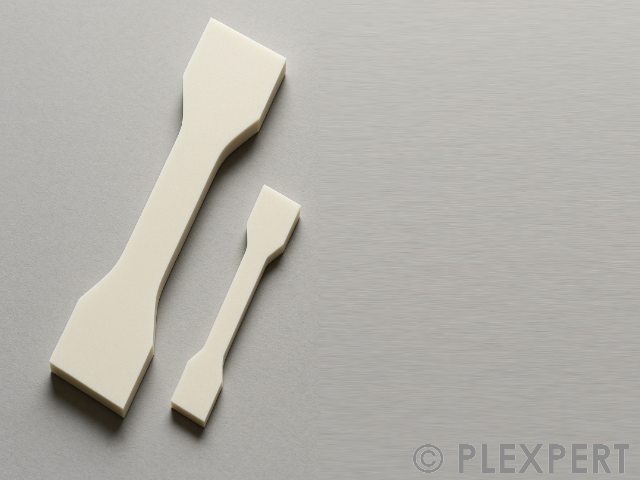
Small and large tensile bar
Related topics:
Impact resistance
This glossary of plastic industry is provided by PLEXPERT Canada Inc.