Dec 19, 2018
When at least two melt fronts meet, a weld line occurs.
Weld lines display on one hand a reduction of the mechanical strength, on the other hand a beauty error in the part.
The lower the melt front temperatures, the more difficult it is for the melt fronts to merge.
The smaller the meeting angle (melt fronts meet head-on), the more critical.
For fiber filled materials, a weld line changes the orientation of the fibers, that they will orient perpendicular to the flow direction.
To reduce weld lines it is possible to work with sequential injection or overflow cavities.

Injection Molding Error: Weld line with narrow meeting angle.
Related topics:
This glossary of plastic industry is provided by PLEXPERT Canada Inc.
Dec 27, 2018
In contrast to the automatically generated report, the Xpertise looks at every simulation result in detail.
This contains comprehensive explanations and suggestions for optimization, as well as DFM Analysis of the part.
Therefore everybody even without special knowledge understands what to do next in the development of the plastic part.
For best quality and high security guarantees the four-eye-system, where at least two experts discuss the results.

Dec 27, 2018
Sharing knowledge on different topics from the plastic industry is done with the Xpress.
The technical oriented newsletter is published by PLEXPERT on a regular basis.
Each time the focus lies on one specific topic, that will be discussed in up to three pages.
It is a good source to follow the actual development in the industry.

Dec 6, 2019
The linear slope of the stress-strain diagram describes the Young’s Modulus of a material.
This reflect the proportional relationship between stress and strain that can be seen by the deformation of a solid body with linear-elastic behavior.
The Young’s Modulus is dependent of the direction and varies therefore especially if anisotropic behavior in a material can be found.
This is also true for cristalline materials.
The higher the Young’s Modulus the more the material resiststhe elastic deformation.
Plastics have a rather small Young’s Modulus compared to steel. In addition to that the modulus depends on temperature as well.
Exmaples at 20 °C:
ABS: 1,9 – 2,6 GPa
PA6: 3,0 – 3,5 GPa
PC: 2,2 – 2,4 GPa
PP: 1,3 – 1,8 GPa
HDPE: 0,5 – 1,2 GPa
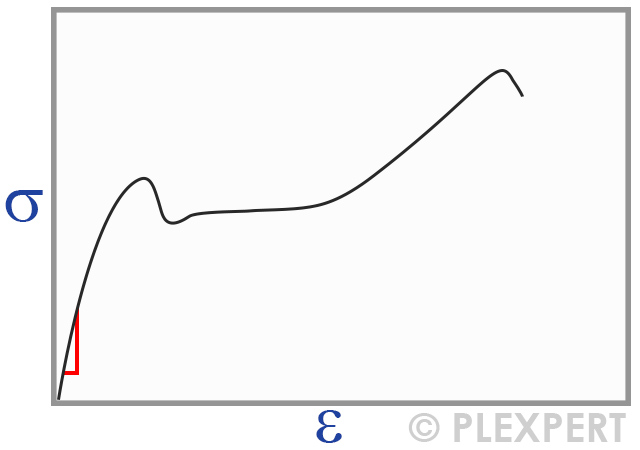
Plastic: Stress-strain diagram of a PA6 material with the Young’s Modulus as slope.
Related topics:
This glossary of plastic industry is provided by PLEXPERT Canada Inc.