Jul 17, 2019
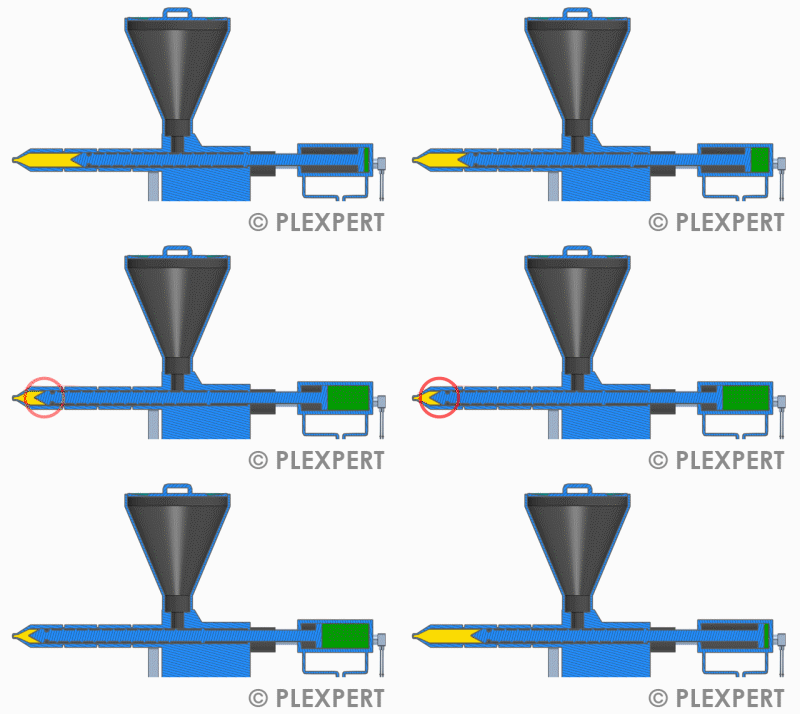
At the end of filling phase, in injection molding there is still melt in front of the screw of the plastification unit.
This amount of melt is needed to to compensate the shrinkage within the cavity during the solidification of the melt.
At the end of packing there is still melt left in front of the nozzle. This amount of melt is the so called melt cushion.
It is used to validate the stability of the injection molding process. There shall be only a small variation in the melt cushion from one shot to another.
A difference might indicate an abrasion of the non-return valve.
Jan 25, 2019
There are different reasons to eject the material from the injection cylinder in front of the mold.
This is done during the start of a machine, after a long residence time in the cylinder or if a change of the material is needed.
If purging compound is used, it will not go into the mold but is collected right after the machine nozzle.
A cylindrical strand of melt emerges from the machine nozzle. The melt accumulates in any form in front of the nozzle.
This form is called the melt ejection.
After the melt is cooled down the melt ejection will be removed from the machine.
Due to it’s irregular shape and it’s weight the melt ejection will not be recycled but thrown away.
Image 1: Plastic: Melt ejection in front of the machine nozzle.
Image 2: Plastic: Melt ejection after it is removed from the machine.
Related topics:
Degeneration
This glossary of plastic industry is provided by PLEXPERT Canada Inc.
Jan 8, 2019
It is easier to use a single value to compare different polymers with each other.
Therefore, for the viscosity commonly the MFI (melt flow index) is used.
This value describes how much mass of a polymer is flowing during 10 minutes at a specific temperature and pressure (mostly 2,16 kg or 5 kg) through a given capillary.
That means the higher the MFI, the smaller the viscosity of the polymer.
The used unit is g/ 10 min.

Nov 16, 2018
During the injection molding process, molten plastic is compelled to fill a feeding system and cavity inside the mold. The melt front shows how molten plastic moves inside the mold over time.
The knowledge about this movement helps to evaluate the filling of the mold.
It shows air traps and weld lines for example.

Quality: The change from one color to the next one shown the
Melt front at one timestep.
Related Topics:
This glossary of plastic industry is provided by PLEXPERT Canada Inc.
Jan 10, 2019
It is easier to use a single value to compare different polymers with each other.
Therefore, for the viscosity commonly the MVR (melt volume-flow rate) is used.
This value describes how much mass of a polymer is flowing during 10 minutes at a specific temperature and pressure (mostly 2,16 kg or 5 kg) through a given capillary.
The measurement of the volume can be done directly during the experiment, therefore no additional step is necessary.
The higher the MVR, the smaller the viscosity of the polymer.
The used unit is cm^3/ 10 min.