Dec 9, 2021
Especially in technical drawings for turned parts, the tolerance mark for the roundness of a part will be found.
This shape tolerance is important when describing cylinders and tapers.
The toleranced circumferential line must lie within two concentric circles with specified spacing in all cutting planes that are executed perpendicular to the center axis.
The tolerance zone is therefore perpendicular to the axis.

Quality Assurance:
Tolerance zone by two concentric circles at a distance of 0.03mm perpendicular to the center line
Related topics:
This glossary of plastic industry is provided by PLEXPERT Canada Inc.
Jan 17, 2019
The machine is pressing the mold halves against each other to counteract the pressure of the melt in injection and packing phase.
The needed force for this is called clamp force.
Most injection molding machines contain this value in their name.
The unit might be displayed in kN or t.
If the clamping force is too low, the mold halves will be pushed away from each other by the melt and flash appears.
The injection molding simulation helps to determine the necessary clamp force in advance to choose a machine with the correct size.
The clamp force can be estimated by multiplying the projected surface with the cavity pressure.
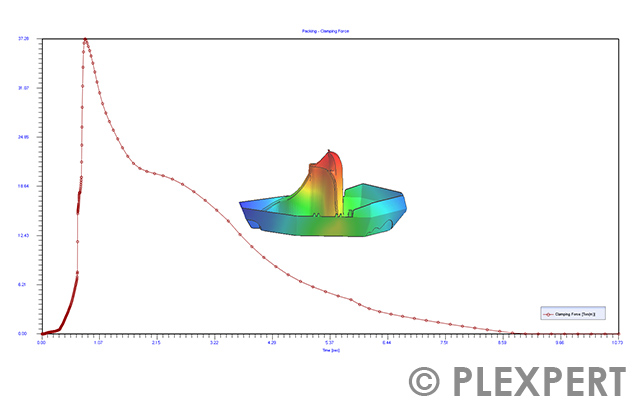
Injection Molding Machine: The curve of the
clamp force helps to choose the correct machine size.
Related topics:
This glossary of plastic industry is provided by PLEXPERT Canada Inc.
Oct 18, 2019
After changing the color or material on plastic processing machines, the new production often causes problems due to material residues within the plasticizing unit or the hot runner.
In order to avoid this, cleaning granulates are used, which make the material switch easier.
As a result of a chemical or mechanical cleaning action, residues, for example in the cylinder of the injection molding machine or on the screw, are dissolved and rinsed out.
Through the use of cleaning granules, the wasted material during production of molded parts and the time for material or color changes is reduced. The duration of the cleaning process depends essentially on the manufacturer’s specifications. While some manufacturers specify reaction times, cleaning granules exist entirely without residence times and can be injected directly after plasticizing. As a rule of thumb two to three times of the maximum dosage volume are required as quantity. The notes of each manufacturer about the quantity should be considered as a reference.
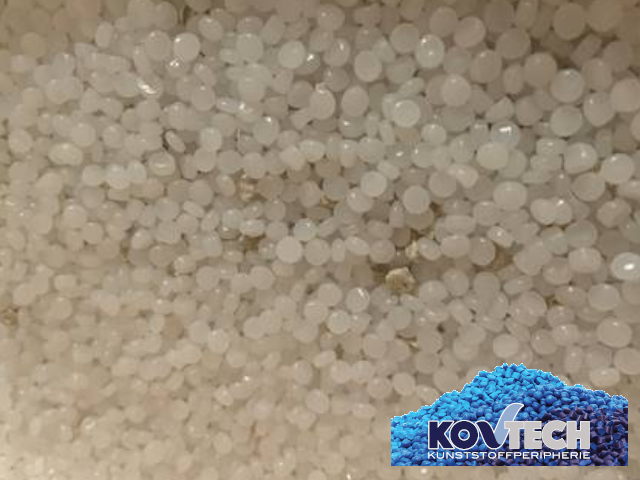
Plastic:
Cleaning Granulate
Related topics:
Cylinder Cleaning
Screw Cleaning
This information and services are provided by:

This glossary of plastic industry is provided by PLEXPERT Canada Inc.
Apr 18, 2024
Special requirements apply to sterile packaging in the medicine or food sector.
To ensure certain degrees of product purity, production must take place in a room under controlled conditions. It is particularly important to remove particles from the air by means of filters. This type of enclosed space with controlled environmental conditions is called a clean room. Clean rooms are divided into different air purity classes according to DIN EN ISO 14644-1.
The cleanliness of the classes is defined by the maximum particle count of different particle sizes.
Four classes (A, B, C and D) are distinguished.
Class A is for high-risk activities, such as the production of aseptic compounds.
Class B describes the environment required to ensure class A.
Classes C and D are defined as work areas for the less critical processes.

Injection molding process: Air purity classes (DIN EN ISO 14644-1)
Related topics:
This information and services are provided by:

This glossary of plastic industry is provided by PLEXPERT Canada Inc.
Apr 18, 2024
In order to meet the requirements of cleanroom technology in injection molding, there are various ways of including the machine.
The technically simplest variant is called “machine-in-room”.
In this case, the injection molding machine is placed completely in the clean room. The additional waste heat from the machine is unfavorable here, since the heat load must be dissipated by the air conditioning in the clean room.
In addition, the machine represents a source of particles.
To avoid this, in the “Machine in room II” concept only the closing area of the machine is integrated into the clean room.
In the so-called “outside-drop” variant, the machine is located completely outside the cleanroom.
To nevertheless ensure cleanroom-compatible production, the mold area is equipped with special filter fan units (FFU), also known as laminar flow modules (LFM). This ensures that the mold area is flown through with hall air filtered to cleanroom level.
In the “Room-in-Room” machine setup, the machine is located in the clean room. The mold area is also equipped with an FFU. The costs of machine maintenance and mold changes must be taken into account. These vary depending on the concept selected.

Injection molding process: Machine
setup variants – Clean areas are highlighted in green.
Related topics:
This information and services are provided by:
This glossary of plastic industry is provided by PLEXPERT Canada Inc.