Oct 8, 2025
Time Tracking refers to the systematic recording, documentation, and evaluation of employees’ working hours within a company. It includes the start and end times of work, breaks, as well as overtime, vacation, and sick leave. Modern electronic systems also enable project-based time tracking and resource management. It supports the optimization of operational processes, compliance with labor regulations, and transparent payroll accounting. Effective time tracking contributes significantly to cost control, productivity improvement, and employee motivation.
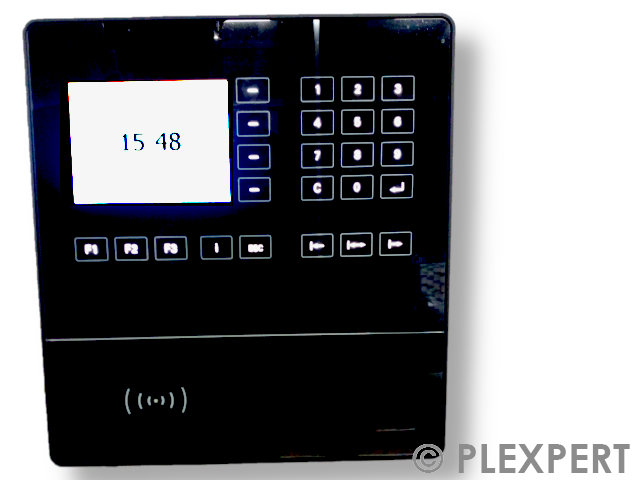
Modern time tracking device
Modern time tracking device in use
Related Topics:
Manufacturing data collection
Human resource management
This glossary of plastic industry is provided by PLEXPERT Canada Inc.
Mar 8, 2019
Shrinkage and warpage can be seen if plastic material is processed and cooled down in the mold and later after ejection.
In order to compensate shrinkage the mold design is modified using a factor, which is very often based on experience.
The given dimension of the part is multiplied by the factor to enlarge the part and create a cavity based on the new dimensions.
A filling simulation can be done to predict warpage due to fiber orientation, stresses, etc. as well as the shrinkage of a part during production.
In order to compensate warpage the cavity is modified in the oposite direction of what can be seen as part warpage.
This modification is called tool adaptation.
To do this in a best way the simulation result warpage is multiplied with a factor of -1 and exported as .stl file for example.
In the CAD system the mold cavity is adjusted taking care of that no undercuts are build in.
It is essential that, based on the new cavity geometry a new simulation is done in order to verify the desired results.
If this simulation shows good results the tool adaptation can be implemented into the mold.

Simulations: Left:
part warpage; right:
tool adaption.[/caption]
Related topics:
Reverse Engineering
This glossary of plastic industry is provided by PLEXPERT Canada Inc.
Dec 9, 2021
This geometric tolerance describes the radial deviation of a target feature when the target is rotated around an axis or straight line.
The specification of a reference point is always required.
A distinction is made between total runout (radial) and total runout (axial):
Total runout (radial) = total runout tolerance.
In this case, the tolerance zone is limited by two coaxial cylinders which are at a specified distance from each other and parallel to the specified reference axis.
Total runout (axial) = Total axial runout tolerance
Two parallel planes at a given distance from each other and perpendicular to the reference axis form the tolerance zone.

Quality Assurance: The shell surface has to be between two cylinders with radial distance 0.2mm
Related topics:
This glossary of plastic industry is provided by PLEXPERT Canada Inc.
Jan 10, 2019
The movement of infrared radiation through an object is called transmission.
Most objects are impermeable to infrared radiation.
Therefore the proportion of transmission is usually set to zero, if the object is measured by an infrared camera.
Exceptions are thin plastic films. Here transmission occurs. An infrared measurement of a thin film usually shows the surface temperature of the underlying object and not the one from the film.