Oct 13, 2020
In injection molding the plastic melt shrinks during cooling down.
Therefore after a volumetric filling of the cavity additional material is pushed into the cavity to compensate the shrinkage.
The phase where the screw still apply pressure to the melt is called packing phase.
Packing pressure (and packing time) is hereby essential.
Too much packing pressure leads to overmolding and flash formation.
Not enough packing pressure results in sink marks, voids and higher shrinkage.
Often a profile is used to apply pressure during the packing phase.

Forward movement of the screw during the packing phase
Related topics:
This glossary of plastic industry is provided by PLEXPERT Canada Inc.
Nov 29, 2018
To compensate the shrinkage, it is necessary to inject more material after 100% filling of the part.
The length of packing time (green line in the time-pressure diagram below ) must be selected in such a way that the gate freeze time is reached.
A short packing time leads to a higher risk of sink marks and voids.
Similar things will happen, if there is still molten material within the part but the gate is already frozen.

Apr 9, 2019
In the plastic industry, different materials (components) are used frequently to create parts with more functionality.
For example:
Components with a different material (e.g. metal) are inserted into the mold before injection molding.
This is done manually or with a robot.
It is important to hold the insert in the correct position until the plastic flows around and fixes the part.
The encapsulation allows a strong connection between insert and part, and both will be ejected as one.

Injection Molding Process: The Inserts (metal connectors) encapsulated by plastic.
Related topics:
Core Shift
This glossary of plastic industry is provided by PLEXPERT Canada Inc.
Jan 15, 2020
A process in which fine powdered material with high melting point (>1.000°C) is mixed with thermoplastic based binders to a moldable compound is called powder injection molding.
The powdered material comes preferred wise in globular shape and corn sizes of 15 µm – 20 µm. The binder is incapsulating the powdered corn.
Volumetric share: Binder > 20 % / powdered material
Mar 24, 2026
This term refers to an auxiliary substance used in plastics processing to prevent a molded part from adhering to the surface of the mold. By applying this substance to the mold surfaces, the demolding of plastic parts becomes easier and the risk of damage or surface defects is reduced. Such agents are particularly used in processes such as injection molding, compression molding, or laminating. They can be applied as a spray, liquid, or solid coating and form a thin separating layer between the mold and the plastic material. This supports a reliable and consistent demolding process.
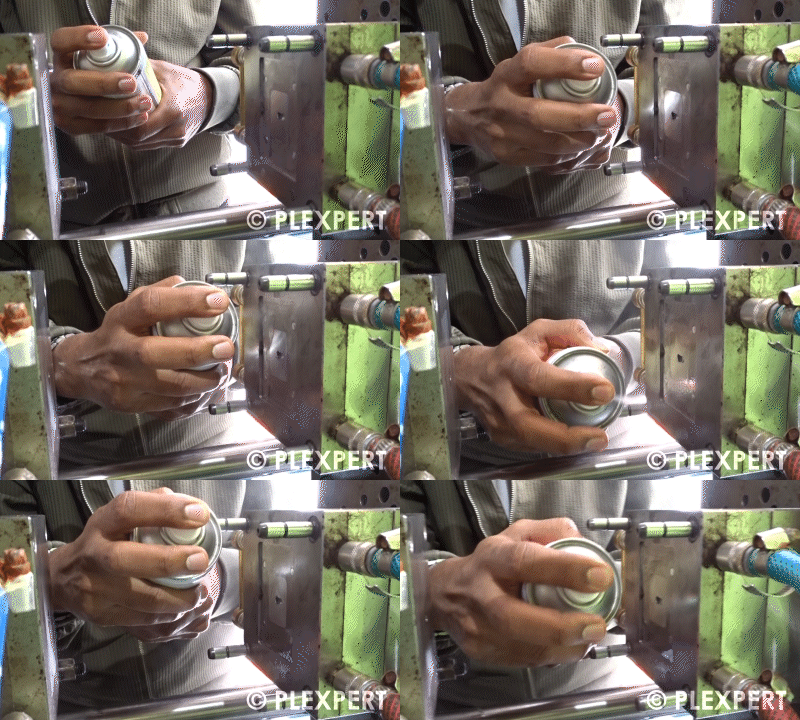
Injection molding process: Applying the release agent to the
ejector side of an injection
mold
Related topics:
Demolding
Injection molding
Molding tool
This glossary of plastic industry is provided by PLEXPERT Canada Inc.