Jan 8, 2019
Glass fibers added into the polymer matrix raise the strength and rigidity of a plastic part.
The fibers are oriented during the injection molding process dependent on the melt flow.
The orientation differs over the wall thickness.
At weld lines, the fibers position perpendicular to the flow direction.
The mentioned effects lead to an anisotropic material behavior.
Anisotropy has an essential influence on strength, rigidity, shrinkage and deformation of the part.

Sep 22, 2019
With a share of nearly 15 % polyethylene is considered a mass plastic resin.
However, there are different polyethylene (PE)-types available.
One of them is called HDPE, where HD stands for high density.
Other names for it are Hard-PE or PE-HD.
In it’s molecular structure the low branched polymer chains lead to a high density between 0.940g/cm³ and 0.970 g/cm³.
Due to its dimensional stability in the temperature range of -50 °C to 70 °C the material is versatile.
As an example, HDPE is used for packaging of food, chemicals or cosmetics.
Pipes, jalousies, foam mats and boats are also made from it.
However, HDPE becomes brittle by UV light and loses its good properties.

Plastic: Spray bottle made of
HDPE.
Related topics:
This glossary of plastic industry is provided by PLEXPERT Canada Inc.
Nov 11, 2019
The heating up of the melt due to shear is called dissipation or shear heating.
In the transition area between the frozen boundary layer and the still flowable melt occurs the highest shear in the melt.
The shear depends on the flow rate of the melt and the cross section of the cavity.
The more shear occurs in the plastic the more the melt is heating up.
Too high shear leads to degradation of molecular chains.
Image 1:Plastic:
Flow rate of the melt over the wall thickness
Image 2:Plastic: Tempersturdistribution over the wall thickness
Related topics:
This information and services are provided by:

This glossary of plastic industry is provided by PLEXPERT Canada Inc.
Sep 22, 2019
With a share of nearly 15 % polyethylene is considered a mass plastic resin.
However, there are different polyethylene (PE)-types available.
One of them is called LDPE, where LD stands for low density.
In its molecular structure, the high branched polymer chains lead to a low density between 0.915g/cm³ and 0.935 g/cm³.
Through the material’s flexibility and corrosion resistance, it can be used in many ways.
As an example, LDPE is used for the production of different containers, but most commonly for plastic bags.
In juice or milk cartons LDPE is needed as barrier film for waterproof.
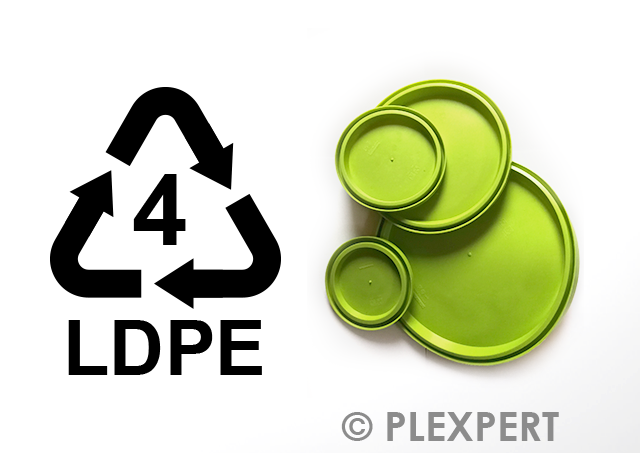
Plastic: Lid out of
LDPE for the usage in the kitchen.
Related topics:
This glossary of plastic industry is provided by PLEXPERT Canada Inc.
Dec 27, 2018
The difference between cavity dimensions and part dimensions after molding is called Linear Shrinkage.
It can be influenced by restrains of the mold, crystallinity and orientation.
The orientation occurs due to shear and extensional forces in the polymer and fillers (if the material contains fillers) during filling and packing phase.
The direction and magnitude of the orientation may vary and has a direct effect on the shrinkage.