Sep 3, 2020
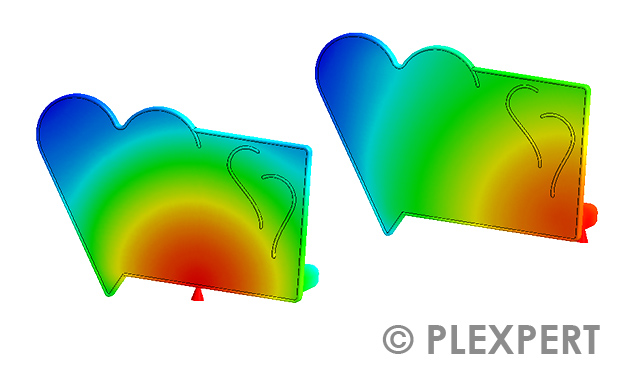
The pressure at different positions inside the cavity/runner is called “Pressure Distribution”.
Ideally in injection molding process, the pressure distribution should be uniform throughout the cavity after the molten plastic completely fills the cavity. In this case the molded part shrinks uniformly.
In reality due to the different cooling behaviour of the part there is always a difference in pressure distribution.
Injection molding simulation is a great tool to predict the pressure inside the cavity, which can help to achieve uniform pressure distribution as good as possible.
Oct 23, 2019
After an injection mold is finished it will get its rating plate.
There is no design of the rating plate generally admitted.
Very often rating plates are created based on factory standards and provided to the mold maker by the future owner of a mold.
There are different online portals available, where rating plates for injection molds can be ordered.
The most common entries are asked for in standard forms.
Often a D&B D-U-N-S® number is requested on the plate besides the name of the mold, the manufacturing date, the size of the mold and its weight.
This number is specific for a given supplier and is used to prevent unjustified passing of the tools to third parties.
The extent to which CE marking is required for tools has not yet been conclusively clarified.
It has to be noted that type plates have to be fixed on the mold and shall not be removable in order to secure the ownership of the mold.

Oct 13, 2020
All melt channels together are called runner or runner system.
For these names, there is no distinction between hot and cold runner.
A good runner is responsible for a balanced filling of the cavity and less material and pressure loss.

The
runner system can contain a combination of hot and
cold runner or only one of the two components.
Related topics:
This glossary of plastic industry is provided by PLEXPERT Canada Inc.
Oct 13, 2020
One parting line is not enough to eject complex geometries of injection molded parts.
Undercuts in the direction of ejection are the main difficulty.
So called slider are used to build an additional parting line.
The movement of the slider diagonally to the opening direction of the mold frees the undercuts and allows the ejection of the part.
Slider can be placed inside the fixed as well as the movable side of the mold.
The angle of the slider compared to the other parts of the mold should be between 83° and 97° to avoid a blocking of the slider.
The buoyancy inside the mold needs to be considered for the correct size of the slider.
It need to be ensured that the sliders are adequately locked.

Opening of a simple
mold with
sliders
Related topics:
This glossary of plastic industry is provided by PLEXPERT Canada Inc.
Apr 8, 2019
In the two shot molding, the second component is commonly soft and elastic.
Therefore, it is also called soft component.
Due to its flexibility, the influence of the soft component on the warpage of the part is very low.
Seals are frequently made as soft component by the two shot molding.
Moreover, TPE is typically used for soft components.