Aug 22, 2019
The primary molding process mainly used in the plastic industry is injection molding.
With the help of the injection molding machine and the influence of heat, the plastic material is brought to a viscous state.
Subsequently, the melt is injected under pressure into the cavity in the mold.
The shape and surface structure is determined by the geometry of the cavity.
Cooling or cross-linking reaction (for elastomers) solidifies the part and it can be ejected after opening the two mold halves.
The injection molding process is particularly suitable for large quantities.
This is due to the fact of high mold costs which need to be payed proportionally by the produced parts.
Injection molded parts can be used directly after ejection.

Jan 5, 2019
The machine builds up an appropriate pressure in order to move the melt into the cavity.
Dependent on the extending flow path length until the flow path end the pressure is rising during filling of the part.
The highest injection pressure can be found usually at the machine nozzle at VP-Switch.
Thin wall thickness leads to a higher pressure difference between melt entrance and melt front.

Nov 29, 2018
In the injection molding process, the period of filling cold runner (if it exists) and cavity is called injection time (purple line in time pressure diagram below).
A slow injection time has the advantage to have less shear and gentler treated material.However, there is the risk of high injection pressure or unfilled parts due to intense cooling of the melt because of a low injection time.

Mar 19, 2026
Heat is generated by the electrical resistance of a conductor when an electric current flows through it. This physical principle is used in plastics processing to heat components such as barrels, tools, or heating plates in a controlled manner. Electrical heating elements convert electrical energy directly into thermal energy, bringing process components to the temperatures required for melting or conditioning plastics. The method enables precise temperature control and is therefore widely used in equipment such as extruders and injection molding machines.
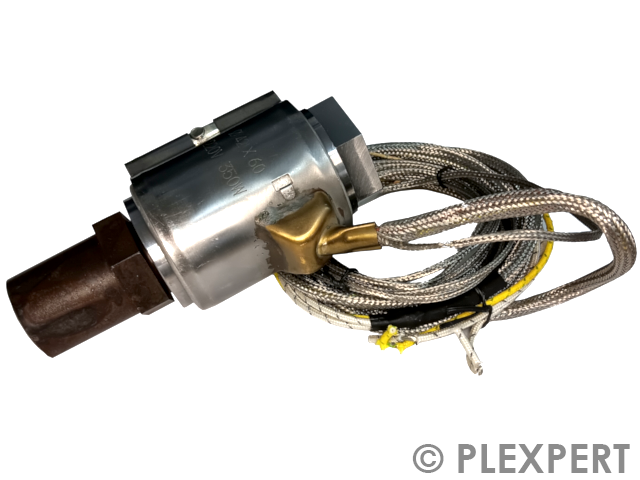
Injection molding process: Heating tape in the area of the machine nozzle, serving as a Joule heater
Related topics:
Extrusion
Injection Molding
Heater Band
This glossary of plastic industry is provided by PLEXPERT Canada Inc.
Dec 6, 2019
Liquid Silicone Rubbers (LSR) for plastic injection molding are delivered standard wise in buckets (2.5kg, 5kg,…).
For processing Component “A” and “B” is required in volume ratio of 1:1.
To assure an equal and constant, same as void-free dosing of material a dosing unit is required.