Jan 8, 2019
In injection molding, the resin to be processed is fed via a hopper into the injection molding machine.
The shape of the hopper can be rounded or squared. The hopper leads into a cylindrical drain inlet connected to the screw cylinder.
The hopper can be moved in axial direction before a material change.
This way its content can be released before it is filled with another material.
The filling of the machine hopper is either be done manually or automatically via a central material supply.
Depending on the application, the hopper is often also equipped with dryers or mixers.

Jun 18, 2019
Handling of parts, mounting elements or modifying existing parts can be done by an industrial robot. It is a machine that can be programmed and used universally according to changing requirements.
In injection molding, industrial robots are used with five or six movable axis.
Their diversity tasks range from the removal of parts out of the cavity up to palatalizing and assembly work.
The increased flexibility compared to standard linear handling units leads to a wide spread of industrial robots in injection molding.
Modern designs feature additional sensors in order to allow the robot to decide what to do in specific situations.
In the best case, a direct cooperation between human and robot (collaborative robot) becomes possible.

Injection molding machine:
Robot with six rotating axis removes an injection
molded part.
Related topics:
Handling (linear)
IdD
Sorting
This glossary of plastic industry is provided by PLEXPERT Canada Inc.
Oct 13, 2020
The injection molding machine can be separated into different units.
At the beginning of the injection molding process stands the injection unit.
It contains the hopper, through which the granule rinses inside the cylinder with the screw.
The rotating screw and the heating rods at the outside of the cylinder cause the melting and homogenization of the plastic while the meld is transferred to the tip of the screw.
Here the plastic is metered for the process.
At the end of the injection unit is a nozzle through which the melt is pushed into the mold by the forward moving screw during during injection.

The
injection unit with
hopper, cylinder, screw and heating rod.
Related topics:
This glossary of plastic industry is provided by PLEXPERT Canada Inc.
May 29, 2019
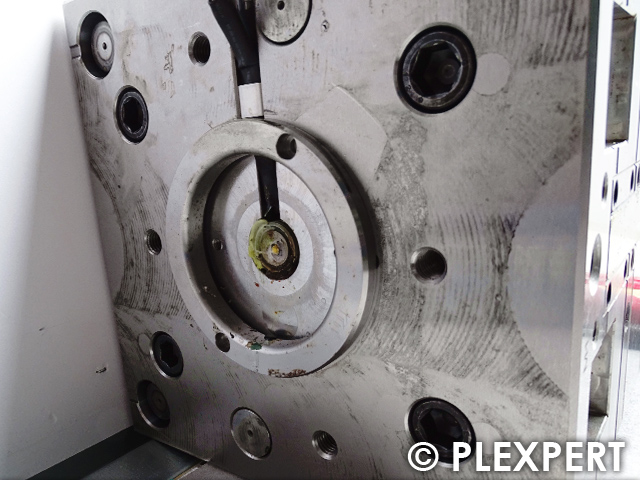
To orient the injection mold on the platen a locating ring is used.
The ring supports the mounting of the mold.
It helps to aligns the machine nozzle with the central length of the sprue bush.
With this, a good contact between the two elements is ensured.