



Do you want to hide this popup?
"Parts, which have been produced from melt by non-cutting molding (e.g. by pressing, compression molding or injection molding) in all side closed molds" are referred
to as molded parts according to DIN 7708, sheet 1 [freely translated].
Thus in injection molding, the end product, which is produced by filling the cavity with molten plastic, is called a molded part.
It should be noted that a possibly existing cold runner is not a component of the molded part.

Related topics:
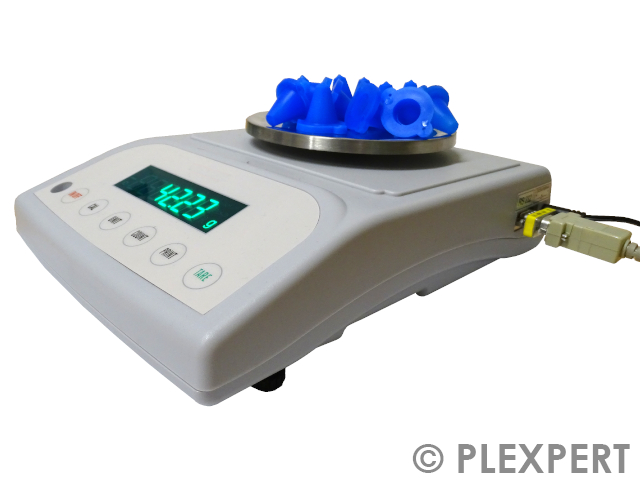
If we want to know how much something weighs we need to determine its weight using a special measuring device called scale.
Historically the first scale was only a simple beam with two strings on each side and a plate attached to each string.
To determine the weight on one side, parts with a known and defined weight where put on the other side as long until the beam comes back into a horizontal position.
Nowadays we use mechanical or electronic scales.
The later converts the weight into a deformation, that can be tracked by a strain gauge and hence leads to a voltage difference.
Related topics:
Temperature plays the most important role if it comes to injection molding.
Before the part is ejected it is good practice to analyse the temperature distribution on the surface.
This is where IR-ThermalSystem comes into play.
It consists of an infrared camera, a magnetic stand, cables some electronic device and a specialized software (called IRDAS), that records
all the critical information from one shot to another.
The system used for quality control, supports a centralized database and can be connected to several other
products that are useful in the injection molding process.
This includes DiagBes as well as Xscale and Xmold.
Evaluating temperature helps to identify short shot and flashing as well as proper functionining of the cooling channels.


The space between the two mold halves, which should be filled with melt, is called cavity.
The shrinkage of the material needs to be considered for the production of the cavity to get dimensionally accurate parts.
In the injection molding simulation, it is important to use the cavity size for the warpage calculation.
The definition of quality according to DIN 55 350/T11 is "the nature of a unit as its suitability to meet specified and required needs".
Different factors are used to evaluate the quality of plastic parts.
The easiest is the optical evaluation.
Visible surfaces should not contain streaks, burn marks, sink marks and/ or air traps.
The dimensional examination is used to control the functionality of the part.
Shrinkage and Warpage are main quality criteria.
The technical drawing shows the necessary tolerances of the part for an acceptable quality.
Mechanical testings are necessary to check the different applied forces on the part dependent on its usage.
Fiber orientation, weld lines, voids and wall thickness may lead to this quality failure.
The choice of the material and the processing, both influence the mentioned quality factors decisively.
Injection molding simulation and additional structure analysis help to check the quality of a part in advance.

A group of experts in the plastic industry founded the company PLEXPERT, 2006 in Germany, in order to save resources, providing a positive impact on budget and environment.
There are two divisions within the company. One is focusing on finite element simulations (FEM) like injection molding simulation and structural analysis.
Based on decades of practical experience DFM conform results are given by the consultant service of PLEXPERT to decrease part costs and increase quality in the production of plastic parts.
The second division is focused on the development and supply of soft- and hardware to the plastic industry. With the state of the art products PLEXPERT contributes to secure production and reduce the need of precious resources.
Today PLEXPERT has offices in Canada, Germany, Thailand and China in order to support its customers fast and effectively.
Due to a close network of plastic experts, partners are available in many other countries as well and offer PLEXPERT products and services.

PLEXPERT Company Logo.
Related topics:
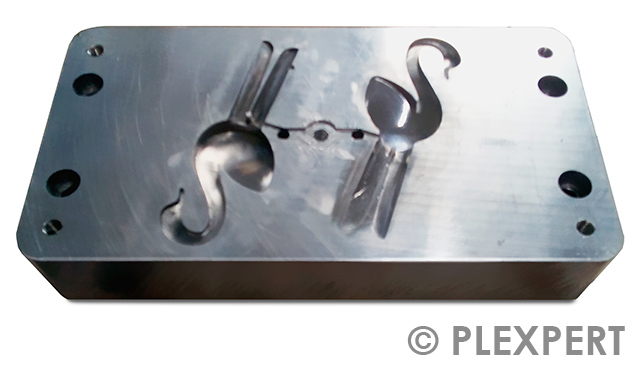
For the production of injection molded parts a mold is necessary to be placed on the injection molding machine.
It is commonly build out of steel or aluminum and is designed as a permanent form.
Depending on the plastic material used millions of parts can be created with one mold.
The complexity of a mold range from a simple two-plate molds up to a complex stack mold with sliders, etc.
To avoid additional costs it is important to think about the mold concept early in the concept phase of part design.

Related topics: